Winning the Race to the System of Action
How to secure the high ground, operationalize doing the work, and win the race to System of Action

Control Points vs. Native AI
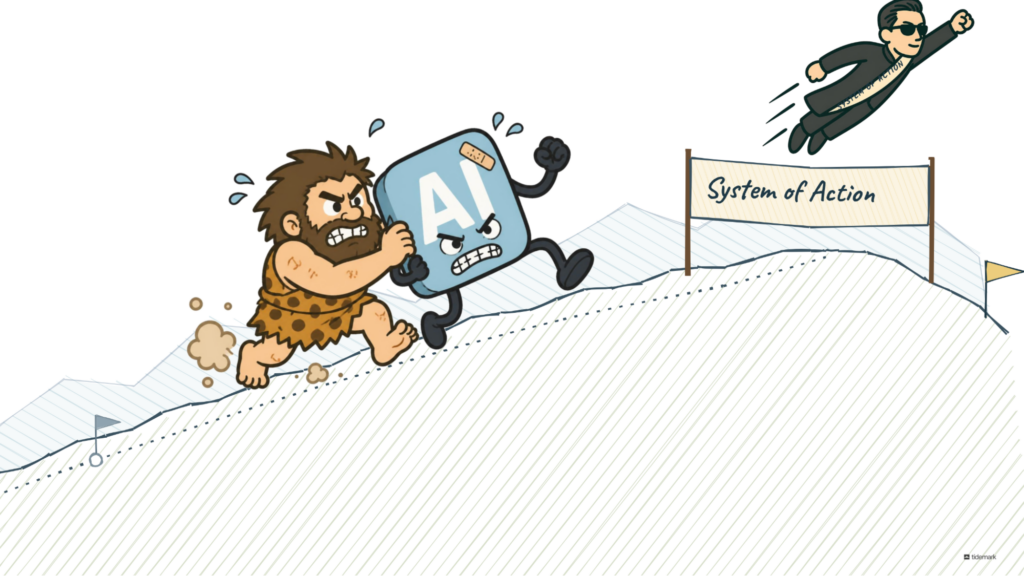
We’ve made the case that frontier labs will not be the System of Action in every industry, so who wins this race? The Control Point leaders or the Native AI challengers?
Prior essays (Tools for Hero Users, Replacing Cousin Richie, and How Control Points Win) touched on this topic, and today we are going deep.
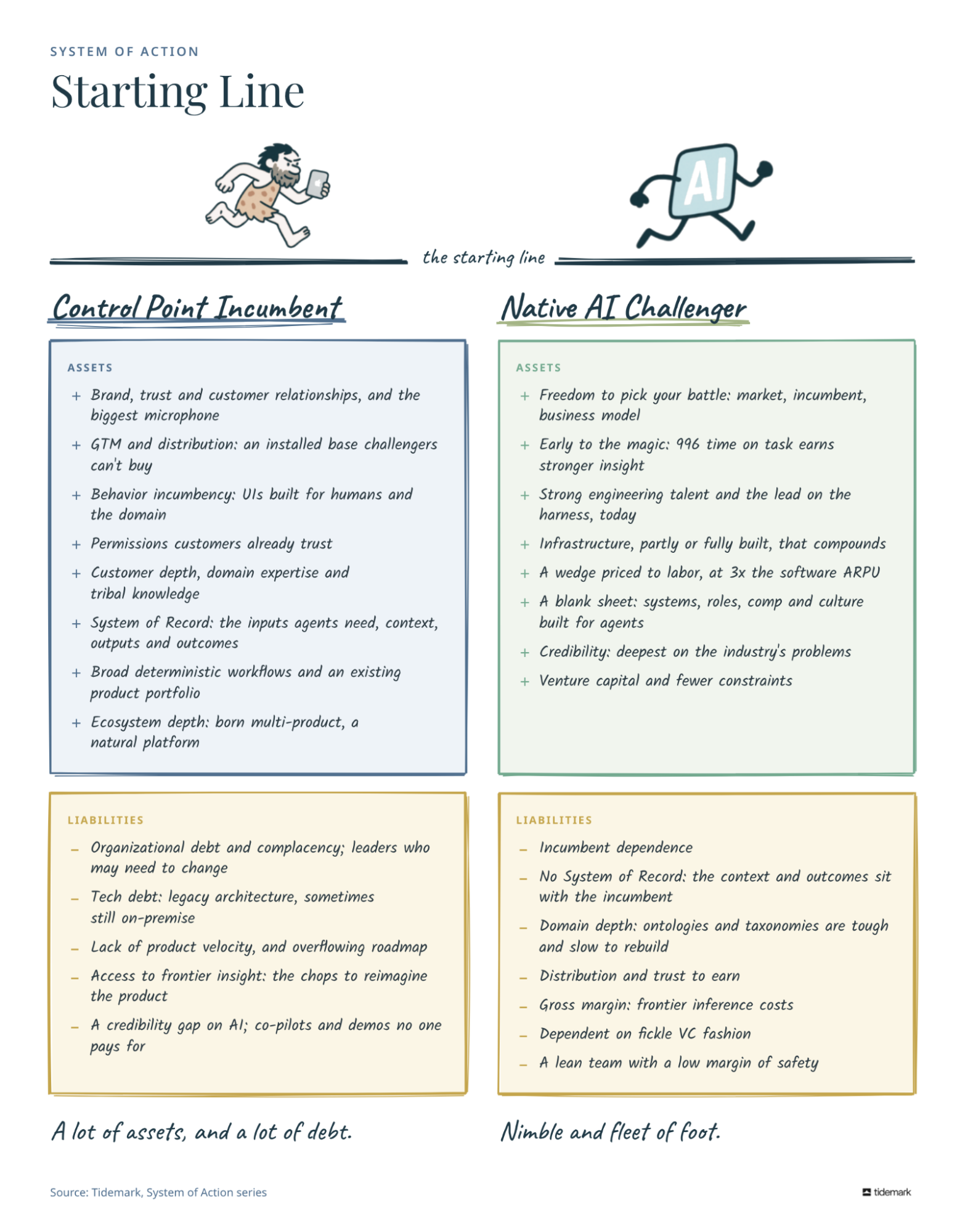
Native AI challengers are early to recognize the magic, raise money, and work 9-9-6, so their time on task earns stronger insight. They apply technology to change the product value proposition, the business model, or both. They build GTM distribution, create a category or a category-leading brand, and win talent and market capitalization from incumbents. Along the way, they need to call the technology shift correctly, navigate fickle VC fashion to secure capital, fight well-capitalized and entrenched incumbents, and execute with a lean team and a low margin of safety.
Meanwhile, Control Point incumbents have structural advantages in brand, distribution, customer base, domain expertise, ecosystem depth, and a broad existing product portfolio. They also carry tech and organizational debt. They need to overcome complacency, secure access to frontier insight, refactor their organization and products, and serve the core business without smothering the new one.
A conversation with an OpenAI researcher framed it well:
“Will (incumbents) have the chops to understand the frontier and reimagine the product? Will native AIs have the domain expertise to reinvent the product? Can they build the distribution to win the market? “Do customers want a reimagined product? Or will they want new tech embedded in their existing (incumbent) workflow?
– OpenAI researcher
So is this the classic case of execution versus structural advantage? Not quite. AI is a bigger shift than SaaS, and it compounds in ways SaaS never did, which means the winner may take most of the market. Below, we lay out why this shift is different, the high ground both sides should race to claim, and how each industry’s starting line favors one side or the other.
Why This Is Different
Scope of Addressability.
SaaS was a Silicon Valley thing; AI is a planetary moment.
The SaaS story was comparatively narrow. Onboarding got easier, you could pay ratably rather than up front, and you could buy an application without getting IT involved. But it was all specific to the software industry, which was much smaller 20 years ago. If your mom didn’t live in the Valley, she probably didn’t care about SaaS (my mom did, but that’s because she’s wicked smart!).
ChatGPT was one of the fastest-growing consumer apps in history, and now Meta’s Muse is even faster. Everyone is worried about AI taking their jobs, destroying their mental health, or blowing up the world. Everyone’s grandma is talking about AI. From a business perspective, AI has the potential to rewrite the economics of whole industries. Businesses are forced to reconsider their products, their org structures, and their business models. AI narratives have already created and destroyed trillions in market cap.
Everyone wants to know where this is going.
Can you think of a better time to create a category and a brand? This gives an edge to the Native AI challengers.
Compounding Advantage.
SaaS changed how software was delivered and sold: multi-tenant hosting, subscription pricing, and revenue recognition. It was different enough to help Salesforce overcome Siebel. But it generally wasn’t different enough to allow SaaS companies to build multiple products or win multiple end markets outside of vertical SaaS.
With agents, product moats and the infrastructure that supports them are interrelated and compounding. Scale begets context, evals, outcomes, and learning, which make agents better over time. Agents can invoke downstream agents without different functional or business-unit users buying and learning your tools.
We believe you’ll see much stronger winner-take-most behavior. As nascent as this market is, we’re already seeing Systems of Action build and commercialize multi-agent, multi-stakeholder, even multi-industry platforms.
Secure the High Ground
The shot clock, as we discussed in Building the System of Action, is the window between what the technology can do and what your industry has adopted. It also measures how much time you have to seize the high ground.
Here’s what we see as the high ground for both the Native AI challenger and the Control Point incumbent.
Be first to market.
The first Waymo ride is magic, but by the third, people are complaining about the seats. Be first to market when customer expectations are lower, and you have a bigger margin to learn from your customers.
If you’re not first to market, the good news is that each major model shift opens up new product capabilities. Jasper was first to market as an AI application and brought explosive revenue growth, but failed to translate its early lead into sustainable moats.
Also, segments and subspecialties have bespoke needs. If there’s a bigger player covering the broad industry, consider going narrower and much deeper.
If you’re the Control Point, you also have the benefit of the gravities and the inputs agents need. As of September 2026, in most markets, if you have an 80% solution, most customers will choose yours. But as the market matures and agents become more valuable, we expect that advantage to compress significantly.
These qualifications aside, if the shot clock is running out in your industry and you’ve fallen behind, it’s time to seriously consider M&A. If you’re a Control Point and you buy an agentic offering with a great technical team, stay out of their way and feed them resources. If you’re the Native AI challenger, use your YOLO valuation to go buy the leading System of Record in the space. It’s winner-take-most. Play to win!
Own the narrative: share your vision for the future.
Everyone is looking for answers. Step into the void. Ironically, the incumbent has the biggest microphone, and sometimes the community’s love and trust. The Native AI challenger has thought about this the longest, has gone the deepest in solving the industry’s problems, and has the most credibility.
This is not your product roadmap. It’s your vision for how your industry moves forward in an uncertain world.
Create the category brand.
Give your customers confidence and agency. Share your vision of how products and services will evolve, how business models and organizations will change, how work itself will get done, and how this might impact each persona’s daily life. Support this vision with survey data and community advocacy to establish authority.
Acknowledge the risks and the uncertainties, but highlight the opportunities. Ceteris paribus, positivity travels further (it’s not an accident that Facebook launched without a dislike button). Specific use cases or magic moments also travel. Find that one magic moment for your industry.
Establish your company and product brand.
As the industry matures (and it’s moving fast), you’ll need to shift focus to your company and product brand. It sounds obvious, but many companies are slow to transition from pitching the merits of the AI and agents to staking a claim that they’re the best partner today (products) and going forward (company).
Is your industry looking for revolution or evolution? Each requires a different approach to brand. Evolution = We’re from the industry (emphasize trust and sensibility), but we’re modern and hip, and we’re changing the way we work with AI. When I think of this archetype, I think of my former portfolio company Xero, which used design & UX to create a modern and human brand in the staid accounting world (read more).
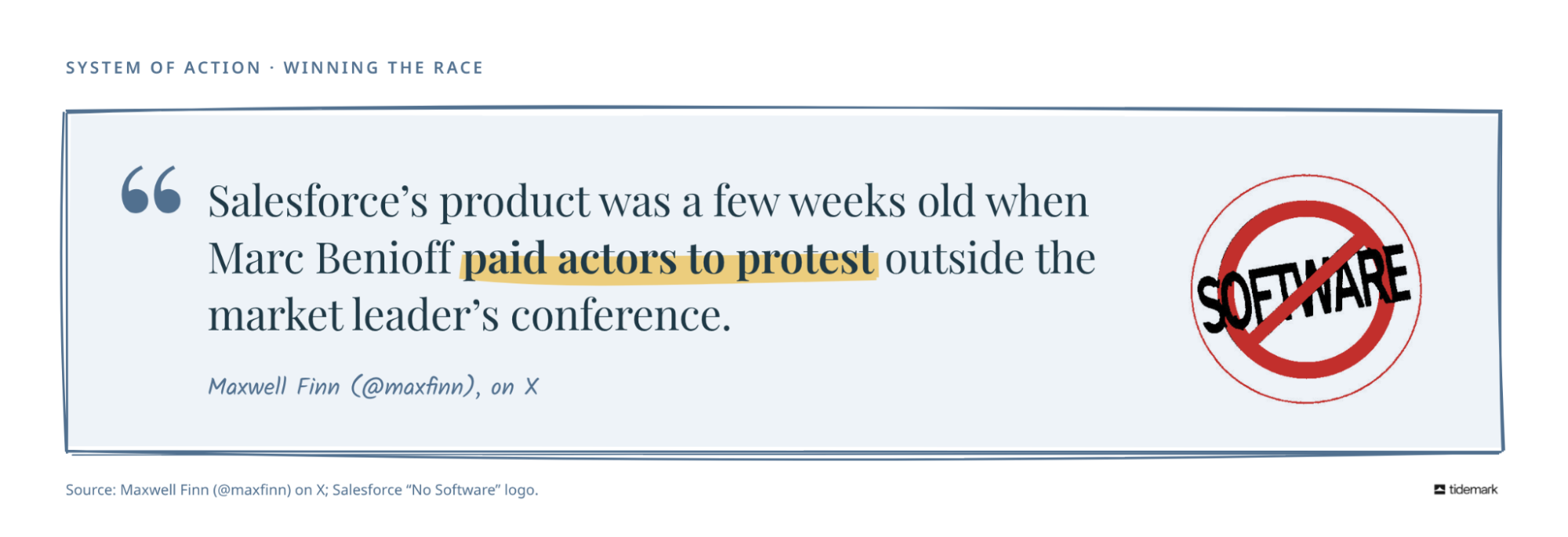
If your end market is looking for revolution, think Salesforce in 2000. Barely a year old, Salesforce hired actors to picket outside incumbent Siebel’s user conference with “No Software” signs. That stunt put them on the map and gave them a tagline to build an industry movement and an iconic brand.
Establishing the product brand is classic product marketing. The one callout is to tread carefully on labor substitution. Establish what is at risk and what will endure. Share how key personas can move from the former to the latter. For what’s at risk, focus on the work people don’t like doing, the “toil”. Make the magic tangible in language customers understand, on their terms.
I love what Nic Kopp is doing in his “Leaders in ERP” interview.
“We use LLMs at the bookends — ingesting messy, unstructured data in and generating natural-language reporting out. But the ledger in the middle stays strictly deterministic. You don’t want an AI ‘vibe-checking’ your books.”
– Nicolas Kopp, Co-founder and CEO of Rillet
In a few sentences, he is telling the controllers and accountants (important Rillet users): your job is safe. Accounting is deterministic, and you’re needed. “You don’t want an AI ‘vibe-checking’ your books.”
Instead, we’re going to eliminate all the stuff you don’t love doing (the toil of data ingestion and reconciliation) and make your life better. Just as importantly, the implied statements are “we understand accounting, we are going to be responsible in a high-risk field, we value your craft.”
Product sequencing: pick your wedge.
There’s no perfect sequencing methodology. And a scoring or purely analytical approach can lead to analysis paralysis, or to poorly defined priorities that are either too tactical (describing features, not products) or too general (justifying any and all initiatives).
The best strategies come from a strong, integrated opinion. It weighs what customers want now and in the future, where the big pools of spend reside, a maturity model for the industry and your customers, and where you can create moats (our System of Action framework).
Your customers may not be able to articulate what they want until they see it. You can sometimes use existence proofs in adjacent markets (hopefully, competitors didn’t beat you to the punch in your market) and prototypes to validate demand.
An explicit customer maturity model will not only help focus your GTM strategy but also feed your product sequencing. Customers can’t buy all your products at once, and you can’t build every potential product. So build products that will see near-term demand and serve the needs of the biggest and most profitable segments.
Operationalize “Doing the Work”
Labor budgets dwarf software budgets. Investors are entranced by “Doing the Work,” so talent is too. Push yourself to think beyond traditional software budgets and explicitly target the big pools of labor. You may not be able to do that directly today, but lay the foundation to get there. If you don’t capture that profit pool, a competitor will, and it will superset your economics.
Administrative work.
Not every industry runs on knowledge work. In a lot of them, the work is lug nuts, steaming hot pots, and big piles of dirt. The work is physical and on-site, and no agent is touching it until robots and world models turn on.
But there’s always admin work: scheduling, quoting, invoicing, collections, payroll, marketing, and compliance. It crowds out what the owners want to be doing and can constrain growth. Nobody opened a restaurant or a shop or a fleet to do any of it.
“This opens up a market opportunity beyond software, marketing, scheduling, payroll, bookkeeping, and tax, which are services restaurants often pay for today. And in many cases, they’re spending a multiple of what they spend on software.”
– Aman Narang, CEO of Toast (Q2 2026 earnings call)
You’ve probably heard this before. So how do you turn this VC missive into actionable product strategy?
Jobs to Be Done.
Map every significant persona at your customer, then take each one’s work apart: the big buckets, broken down to the task level, and the hours that go into each in a representative week.
For each task, ask: Can this be automated by an agent, a deterministic workflow, or a service-wrapped hybrid? Then run it a second time through the customer politics: Would your customer want to automate, and would they trust you to automate?
A general hint: the easiest labor substitution is either cutting outsourced labor spend (concrete spend avoidance, and it’s easier to fire someone who isn’t your colleague) or avoiding FTE hires that would otherwise bottleneck your customer’s growth.
Then price it. Wage rate against the hours gives you cost. Bill rate gives you revenue. Now you have a map of your industry’s profit pools, grounded in your customers’ operations rather than a theoretical McKinsey exercise.
Done correctly, it’s also your customer’s business model: the one they run today and the one they could run three years from now. It’s their ROI case and their map to the future.
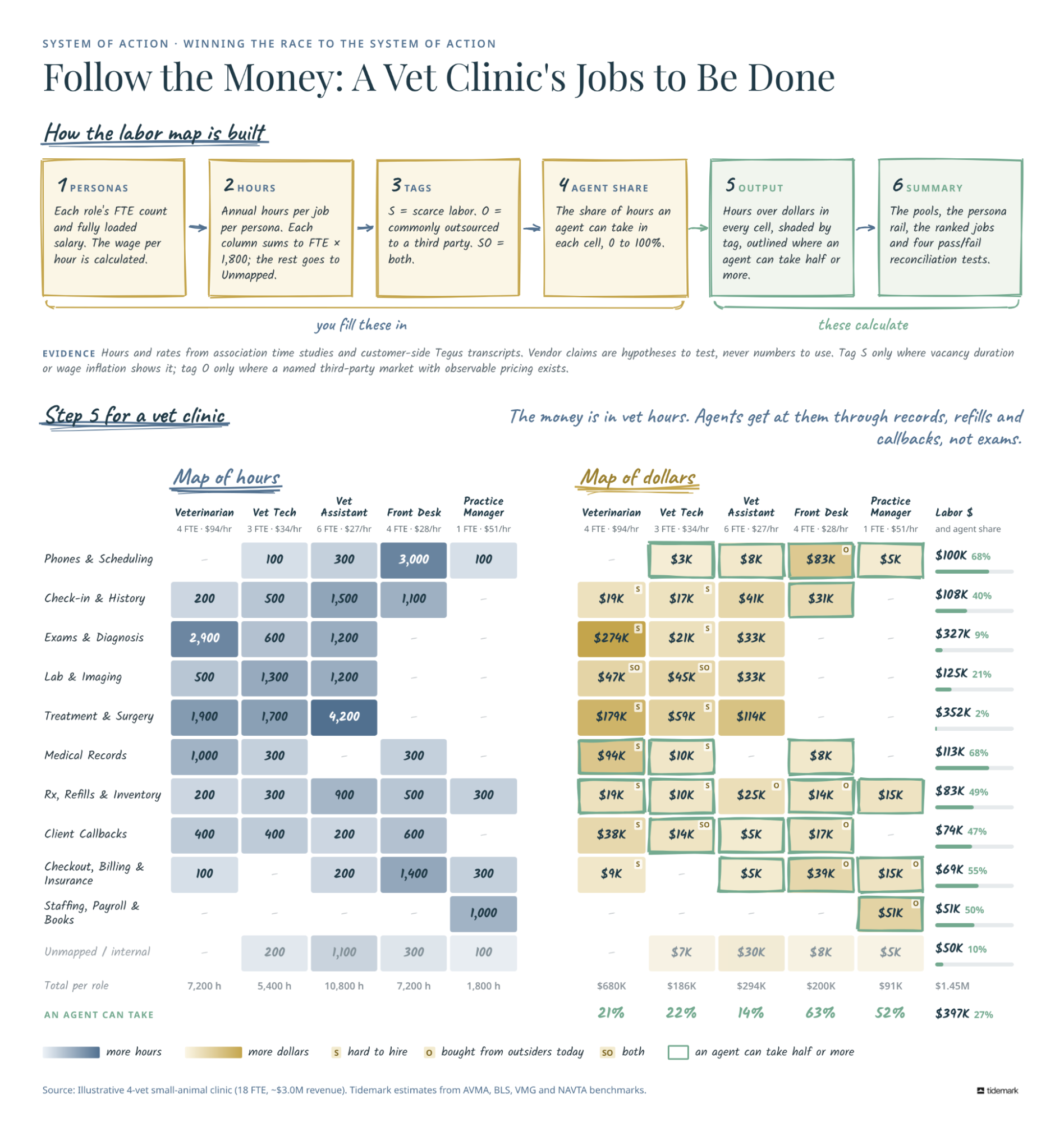
This exercise can be a big lift. But there are ways to get a directional view quickly. Many industries have third-party research shops fielding surveys on staffing, rates, and utilization. You’ve got deep subject-matter experts on your own payroll and a customer advisory board that lives this every day. That combination can get you to more than directionally correct and point you to the high ground.
We’ve also built applied frameworks to help you get started. (Reach out to your friendly Tidemark representative or [email protected] if you’d like to run through the exercise together.)
Earn the right to act.
Decisions > Advice.
Anyone who has tried to pick a restaurant for a group of 10 knows that decisions are much more valuable than opinions or advice. Decisions allow you to take action (trigger workflows, invoke tools), and that’s how you hit business goals, whether bringing in revenue or reducing cost. Decisions invite feedback and learning. And good decisions earn trust and more autonomy.
Moving up the Stakes Ladder.
Most of the time, you need to earn trust with the customer to move up.
Start with lower-stakes decisions that are reversible, well understood, or lower value. Logistics AI-native HappyRobot allows its broker customers to manage stakes in a wide range of ways. At one mid-size broker, about 8% of loads book with zero human intervention. Another allows autonomous booking only for in-network (pre-vetted) carriers on loads 3+ days out (which are reversible). A third caps it at tenders under $100K.
Multi-agent
Vertical SaaS Control Points are “born multi-product.” Systems of Action are likewise born multi-agent.
Different mechanisms, but the same overarching function. Each agent both adds gravity and benefits from other agents the same way additional products did in the vertical SaaS era. Multi-agent thinking is how Native AIs “integrate and surround,” and it’s also how Control Points become the System of Action.
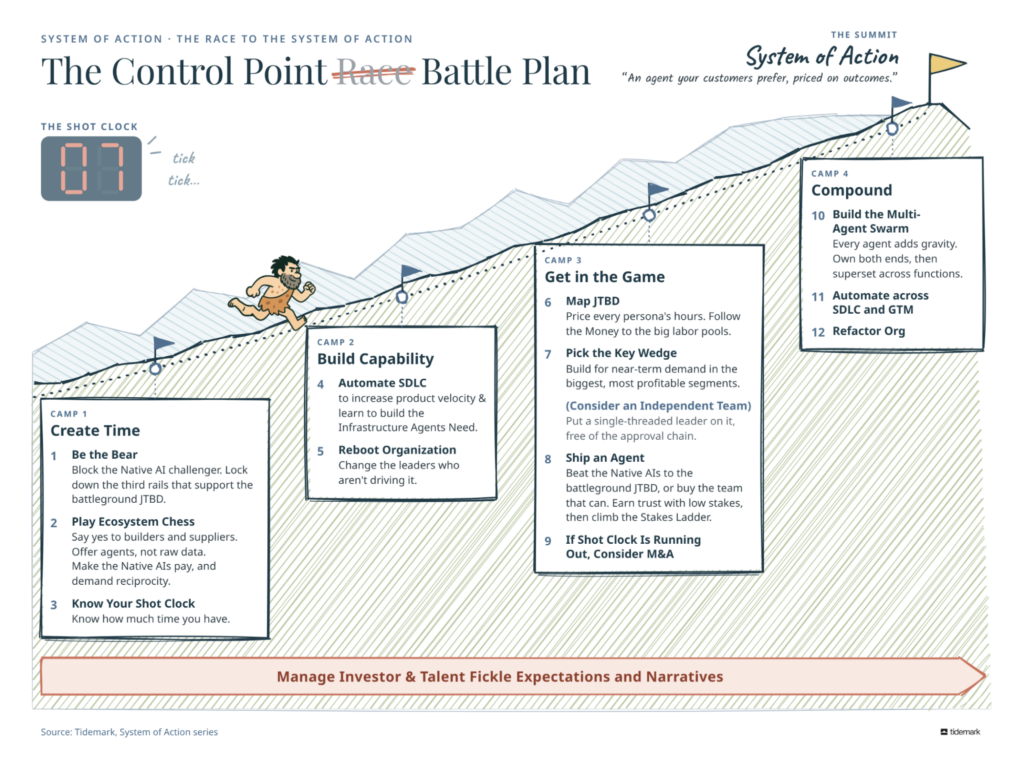
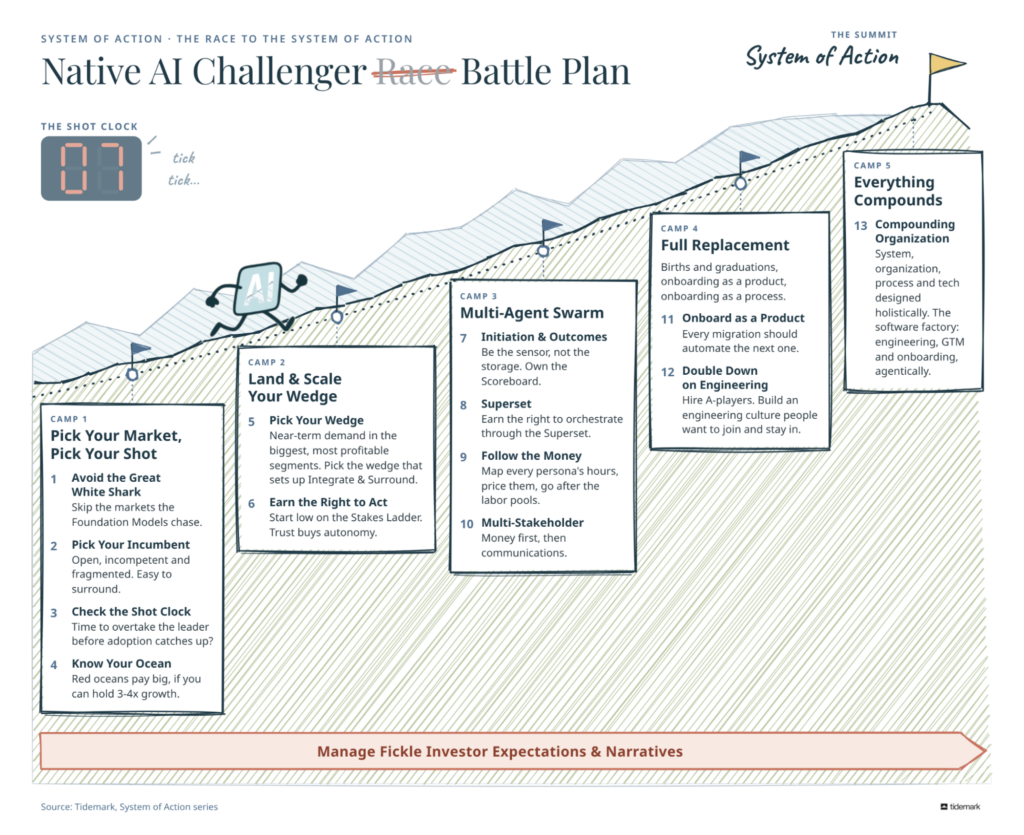
We’ll explore this in much more detail in The Native AI Race Plan (see the Integrate & Surround section in our essay on Control Points).
The starting line
It’s lazy to declare either “the Control Point will always win” or, more popularly, “SaaS is dead.” (Just as lazy as saying the foundation models will eat the application layer.)
Each industry’s structure is unique, and the race will be determined by the urgency, the strategy, and the hustle of the respective competitors.
In industries open to revolution (eager to reinvent their work and the customer experience), UI and workflow gravity are far less impactful. Those markets favor the Native AI challengers. In markets looking for evolution (eager to maintain their existing workflows), Control Points are much more strongly positioned.
Below are the respective starting assets and liabilities of the Control Point incumbent and the Native AI challenger. Next, we’ll walk through the race plan for each.