Tools for Hero Users
Win the scarce expert who picks her own tools, then grow the wedge into a System of Action.

Introduction
Some verticals have a Hero User who is scarce, uniquely influential, and has the agency to buy her own tools. All three matter. Ideally, she’s reachable, and you can acquire her with PLG/self-service tactics — easy to try, easy to buy, easy to use.
Provide her with a magical wedge: first a co-pilot that gets rid of the drudgery of her work — transcription for the therapist who would otherwise need to stay up until 11 pm to write up her notes; then an agent to automate the tasks that aren’t currently being done — filing a claim, setting up a follow-up appointment — and you’ve won her as a customer.
The best wedges are at the start of a process so that they can build in hooks to initiate an important workflow and extract from and write to the System of Record.
If you’re a Native AI challenger, the incumbent Control Point might try to block you. But if you’ve built user scale, you can exert that collective user leverage on your behalf to force integration.
The payoff is that soon the users are triggering actions and writing and reading data from your product. You can use that wedge position to add subledgers or calendars, and quietly begin to capture downstream workflows.
If you keep compounding functionality, your wedge will grow into a System of Action over time.
Run the Business vs. Do the Work
Forever ago, when dinosaurs roamed the earth, vertical software was sometimes called “business management software.” Today, it’s sometimes called “property management software” or “practice management software.” All of these names point to the same thing: vertical SaaS has historically focused on running and managing a business, not doing the actual work of the business itself.
For example, legal practice management systems focus on providing tools to run a law practice, onboarding clients, managing the workflow and tasks of various employees, sending invoices to clients, and collecting payments. What they generally don’t do is help lawyers actually practice law.
The goal of vertical SaaS is generally to provide workflow software that helps owners and managers run the business consistently, efficiently, and profitably. And because they sell to owners, they haven’t always needed a delightful user experience to succeed.
Sarah Tavel’s advocacy for “selling the work, not software” recognizes AI’s new capabilities to narrow the gap between empowerment and outcomes. These new capabilities blur the line between running the business and doing the work itself.
In the following example, transcription tools start by automating the administrative task of documenting and summarizing patient notes. But thereafter, it’s not hard to imagine triggering administrative tasks like follow-up scheduling, invoicing, and even clinical recommendations.
In verticals where the practitioners are influential, this provides an opening for the Native AIs. They can target Hero users with tools that actually do more of the work.
So, who counts as a Hero User? Hero users are those who:
- Are highly influential and valued because they are scarce or add unique value.
- Are solo contributors or work independently. If they aren’t heavily matrixed or ensconced in multi-person workflows, they can quickly pick up new tools.
- Have agency within the company to choose and buy tools independently.
If a merchant has employees like this, a native AI can offer them tools that make their lives easier. The best Hero users to target do digitally native work (vs. physical labor) that involves lots of manual drudgery, data entry, reconciliation, summarization, tagging, that AI can eliminate. If the experience is “magical” enough, the native AI can quickly acquire these Hero users.
If you own the Hero user, you have a head start on becoming the System of Action.
The Race to the System of Action
To understand what the System of Action means, start with the fundamentals.
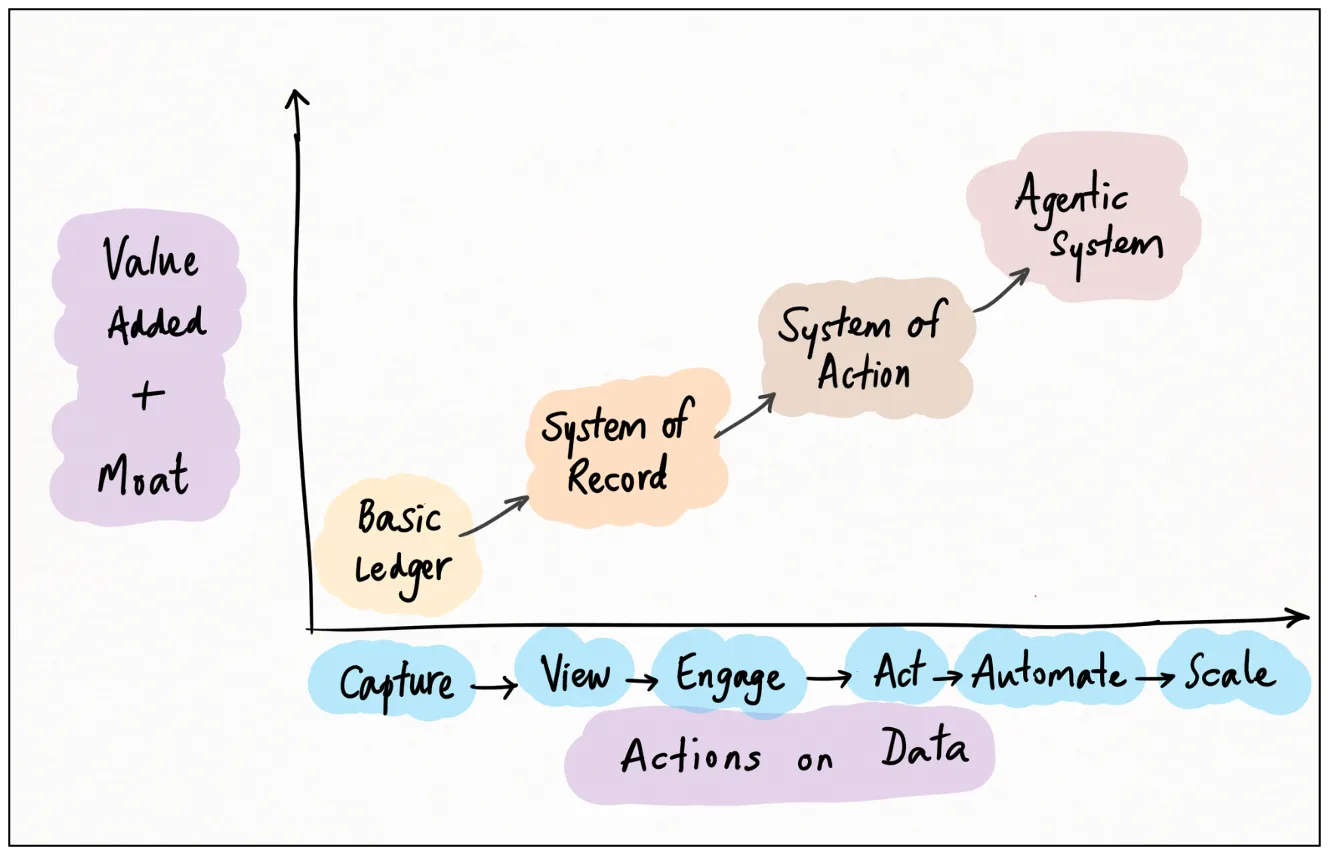
Software applications take in data via human or system input. They analyze that data, present it to humans to inform decisions (typically via dashboards or apps), and/or trigger actions – either by humans or other applications.
When done in a digital workflow with learning loops, workflows where the AI can learn and improve over time and a human remains in the loop for quality control, more and more of these tasks can move toward higher levels of automation. That’s the foundation for what we call a “System of Action.”
(This is a broader overview. We describe it in far more depth in our flagship essay: Why AI Needs an Application Layer).
The goal is not just to reduce headcount (although that’s often a natural byproduct), but to make the experience more effective, more efficient, and more “magical.”
If you’re not in the system where this progression of work – from human action, to human + agent action, to full AI agent action – is done, then you’ve already lost the race!
And this is why: the system where this work is done has the right to pull in all the data (usurping data gravity), and to drive downstream workflows and actions (stealing workflow gravity).
Who owns the System of Action?
The existing system of record (i.e., the Control Point) is the logical incumbent. But if a Native AI can win the hearts and minds of the Hero users, it can flip the script and become the system that decides and triggers downstream actions. They can usurp the system of record’s data gravity and become the System of Action.
It’s easier to see through examples. So let’s get into it.
How to Kill a Control Point: A Hypothetical Case Study
Consider the veterinary clinic software market. The control point is typically the practice management system (PMS), historically powerful because of its strong workflow and data gravity.
There are two types of gravities to note here. Workflow gravity comes from client communications, scheduling, and billing. While the data gravity stems from the electronic health record (EHR), where notes and patient records are stored.
A practice management suite can serve as both the front- and back-office control point. Done well, it is a true operating system that captures the vast majority of a merchant’s software spend.
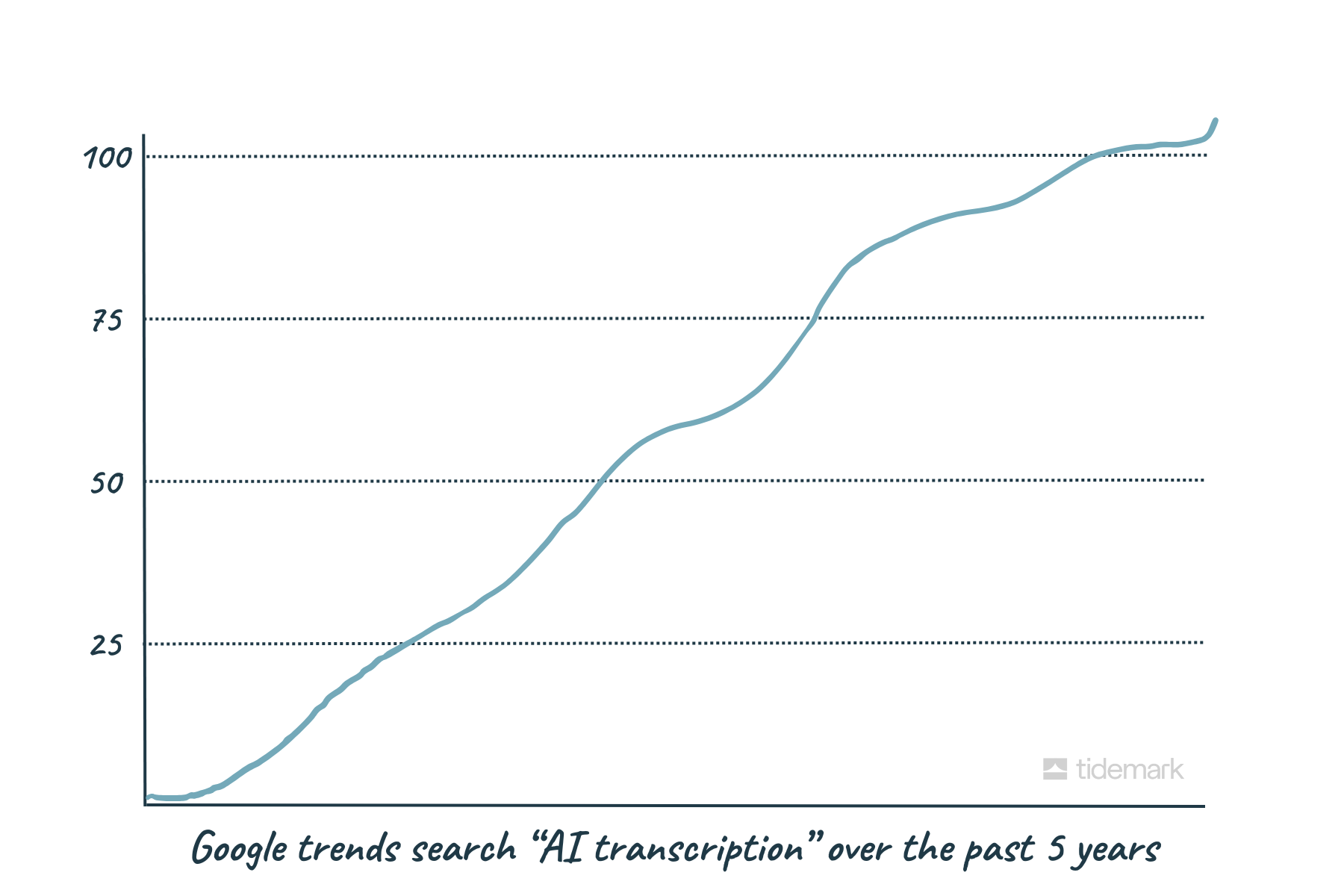
Into this stable market emerge these seemingly flimsy AI transcription tools. Initially dismissed as ChatGPT wrappers with none of the capabilities or sophisticated infrastructure traditionally respected by incumbents. Yet these tools address a painful gap: veterinarians’ struggles with documentation.
What looks like a harmless wrapper to a tech incumbent is a lifeline to an exhausted vet. Veterinarians, already scarce and overworked, often spend hours transcribing notes after dinner. Burnout is a real issue. A tool that can automatically transcribe session notes is transformative and gives them their lives back.
These native AI solutions offer a magical, visceral experience: veterinarians previously burdened by hours of post-session documentation can now finish their notes during sessions and get back to living.
Despite clear market demand, the incumbents hesitate – choosing to “gold plate” their offerings by waiting until transcription can be flawlessly integrated into their EHR, calendaring, and billing workflows. The team also faces a steep learning curve, with a strong workflow for control and compliance but not for a solo user experience.
Then, it’s tough to get the sales team to pay attention. Sales reps don’t know how to sell it, and low price points mean low commissions. Add to that a marketing team with little instinct for PLG – and fear that a PLG funnel will cannibalize their traditional demo-request motion – and the result is a perfect storm of friction.
Nothing gets done. In prioritizing perfection, founders ignore the immediate needs of users who were pretty clear about what they wanted, if the incumbent had been paying attention.
Meanwhile, the native AI startup capitalizes on the incumbent’s delay. Sure, their product is “just a wrapper,” but the user experience is great, so who cares? By wrapping the wrapper (heh!) in vertical-specific language, templates, a fast, easy UI, and great prompts, they make the product feel tailor-made for veterinarians. Leveraging a PLG strategy, they offer an easy-to-try solution designed specifically for veterinary professionals.
Veterinarians quickly adopt the solution and appreciate its immediate, tangible benefits, driving swift market penetration. With learning loops, the product improves quickly, attracting more users. Buoyed by rapid user adoption, the AI startup raises substantial venture funding, further accelerating its growth.
As its user base expands, the startup begins to force integrations into the existing PMS – initially via tactical methods like Chrome extensions and robotic process automation (RPA). They may even create a virtual user in the PMS that mimics other human users to control the system.
Eventually, the sheer volume of user demand compels incumbent providers to formally integrate the AI transcription tool – effectively ceding ground to the Native AI.
And so begins the land and expand. With formal integrations secured, the native AI provider begins to expand its product capabilities, incrementally taking control of downstream workflows, scheduling, billing, and payments, previously dominated by the incumbent. They leverage the data from the incumbent’s system of record to launch even more AI-driven features. They link transcribed notes to billing codes, significantly streamlining the billing process. They introduce their own scheduling system and begin extracting and managing calendar data from the PMS.
They may even provide an alternative billing and payments workflow that is 3x the PMS monetization. With a lower-cost distribution model and higher ARPU (and a lot of venture money), they take it to the Control Point and start to offer big parts of PMS functionality for lower cost or free.
Then? It’s game over. The incumbent is done. They just don’t know it yet.
What can we learn from this hypothetical case study? What’s really going on here?
Let’s look at it from both the Native AI and incumbent SaaS perspective.
Native AI Strategy Abstracted
We’ve talked about picking your market based on TAM and fragmentation. Now, add another criterion to the list: a slow-moving incumbent.
The good news? This is much of the world. Thoma Bravo recently shared that SaaS is only 25% of $5.9 trillion in software spend – outweighed by on-prem and hosted. That’s a lot of old companies for AI founders to devour.
Once you select your market, you focus on the Hero user and the work that they do. You want to solve their most compelling problem. Keep in mind it may not always align with what’s most compelling to the business owner.
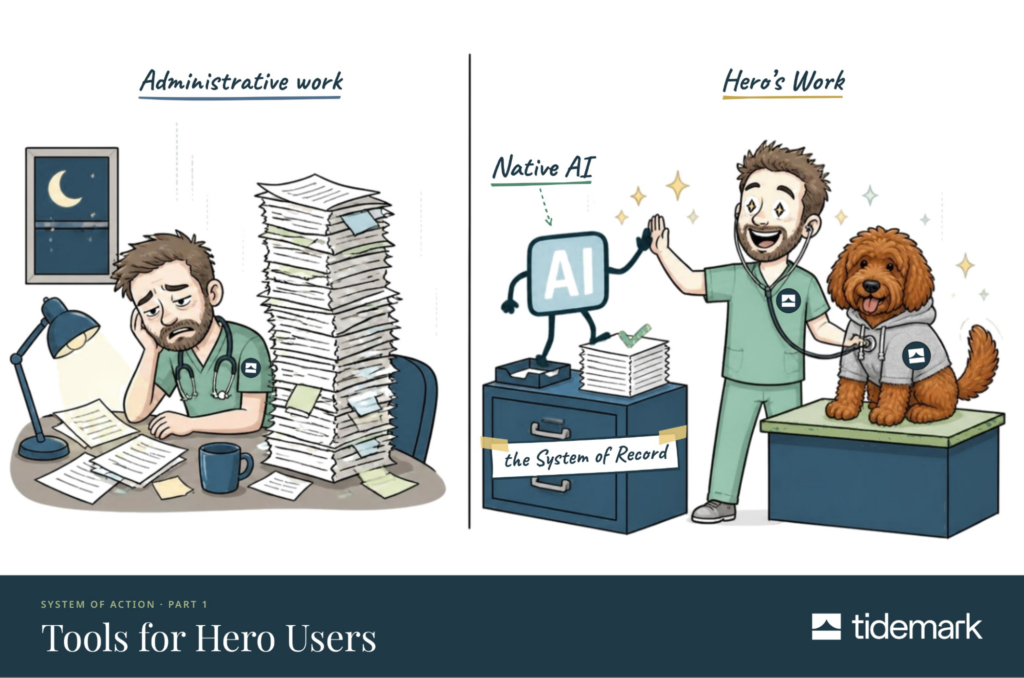
Help the Hero do the “Hero’s Work” better and automate the “Administrative work” from their life. (We’ll publish a subsequent essay talking through scenarios where the Hero user doesn’t have sufficient agency.)
Ideally, this work sits at the start of an important workflow and is key to decisioning or actioning the next step (we call this Initiation). This gives the native AI a right to be the System of Action and an opportunity to expand its offering over time.
| Three Types of Work
There are generally three types of work that a Native AI should consider:
|
Then comes the hard part – making magic.
You are past the science portion of the work. Now, it’s time for the art.
You need to deliver a magical experience for the user – even if the tech behind it isn’t groundbreaking. Wrappers are totally ok to start with! Ideally, the product has strong learning loops. It may be a wrapper over some other player’s infrastructure, but it gets better with usage.
It learns from user input on correct and incorrect outputs. It may observe user actions or workflows, detecting informal but important patterns and context. The more the product is used, the more it learns and improves to stay ahead of incumbents and other entrants.
Your GTM playbook is more likely classic PLG than sales-driven. Your products should be easy to try, buy, and find:
- Tryable: Free trials or standalone offerings that don’t require integrations, with a simple, intuitive UI.
- Buyable: Initial price point at the user requisition level such that they can just swipe their credit card without a second thought. Afterward, you scale the deal size with usage and value.
- Findable: PLG sales motions help, but we’ve seen product wedges go viral via strong content marketing, referral flywheels, and SEO.
Once you have acquired a meaningful community of these customers and they are finding daily delight in your wedge, you can “integrate and surround” the incumbent’s control point.
Your goal is to integrate into the system of record. You’ll start with scrappy tactics: copy/paste, Chrome extensions, RPA. But when you reach scale, have your users demand integration for you. In our case study, that would mean syncing transcription with EHR notes. From there, you start triggering downstream actions in workflows.
This is the moment you start beating down the incumbent and getting aggressive.
Pull in or replicate core functionality from the system of record into your own product. Then look for adjacent or downstream expansions to add ARPU fuel.
Or, because customers already trust you for all things “magic AI,” you create alternate high-value/high-monetization workflows to increase your economics. Look for 5x + ARPU opportunities like claims management and insurance billing. (Here we cover which expansion products offer the best returns)
You then use that revenue fuel to expand the product, field a sales team, and lower pricing if the Control Point tries to bundle in a competing offer.
This is a good story and one that many investors are deploying capital for.
The Incumbent Opportunity
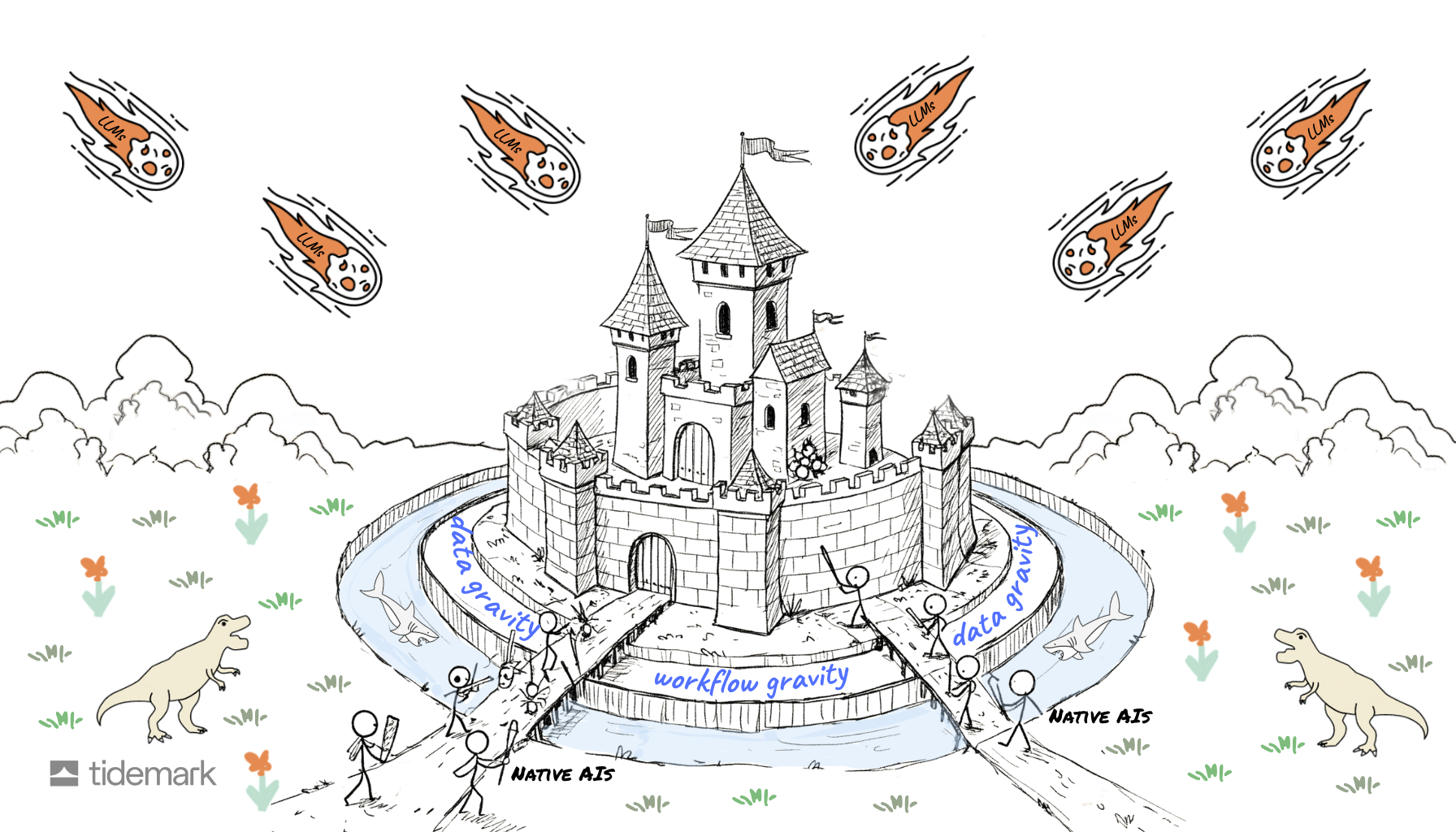
Native AIs are coming. They may be hidden in incubators and Silicon Valley garages, but you need to watch your back!
Think through the work your heroes are doing. You are looking for the “Hero’s work” you can empower, and the administrative work you can automate. Look to your user groups or survey your base for clues—many fast-scaling tools are addressing these pain points, even if they seem outside your traditional scope. You need to expand your scope beyond running the business, to understanding how your software can help its merchants do the work.
Build Products for users, not owners. Learn from your native AI competitors. Hero users want tools that are easy to try, easy to buy. An empowered Hero should be able to download your product, test it, validate that it works, and purchase—all within five minutes. That means deprioritizing sales enablement bells and whistles like demos, onboarding calls, and SSO (at least for now).
The goal is to build products that delight Heroes, not win Nobel Prizes (h/t my fellow board member Kent Bennett). Yes, we love technical maturity, models. But your goal is to build a product that delivers value for your users, not win the local science fair. Wrappers are fine! Concepts should be able to be prototyped quickly.
Great is the enemy of good. You have amazing data. You have powerful workflows. Great. Get over it! You need to ship something, NOW! It may be just a “wrapper” on public infrastructure, but as long as it adds value to your Heroes, you are capturing the high ground. You can show the roadmap of how this all comes together in incredible ways in the future, but launch something today.
Find Heroes where they are. Sell to them how they want to buy. You may be a sales-led company, but it’s now time to learn PLG.
Protect your flanks to fight off the “integrate and surround” strategy. Who are the Hero users in your merchants? What key systems of record do they work with and rely on? In our case study, it was the electronic health record system and the calendar. In other industries, look for systems where merchants bring in revenue and engage with customers––e.g online ordering, channel management, or e-commerce. (See our discussion on these key systems in our consumer extension essay.)
Once you’ve identified these systems, lock them down. Ensure all your customers are using your version. Consider making them free through bundling or freemium models. Do your best Jrue Holiday impression and play lockdown defense––making integration tough on all challengers. No API access, no MCP integration. Block all the little hacks and tricks, even if they seem initially harmless. If you’ve already opened these up, you’ll need to have some uncomfortable API and partnership discussions.
Engagement first, money later. Success = engagement, not monetization. We love monetization layer cakes, but you’re looking to win influential users and engagement as quickly as possible. Measure DAUs for daily work and WAUs for weekly work. And let your CFO know: you’re okay to try bundling or even going free (gasp) to ensure long-term victory. You can always add paid tiers with advanced functionality later.
If you’ve made it this far, congrats—you’ve likely headed off that pesky native AI at the pass.
Of course, while you’re doing all of this, lay the foundation for the agentic age:
- Infrastructural build: Design your infrastructure for modularity and adaptability to enable rapid experimentation and easy integration of evolving AI capabilities.
- Reconsider different pricing models: Transition pricing strategies from static seats to value-driven usage metrics, aligning your revenue with the tangible outcomes AI delivers.
- AI skills and cultural enablement: Foster a culture of trust, transparency, and user control by embedding clear AI governance and explainability directly into your products.
- GTM enablement: Implement product-led growth strategies that empower influential users (“Heroes”) to discover, trial, and advocate for your AI-enhanced tools organically.
Ultimately, success hinges on who secures the system of action first––embedding deeply into daily operations and critical workflows, whether incumbent or native AI, controlling user engagement and workflow integration will determine who dominates the AI era.
Ending Note: The Brave New Agentic World.
If you own the System of Action, you transform how you serve your customers, your TAM, and your overall economics. You’re no longer just helping merchants run and manage their businesses. You’re helping them do the work itself.
We are actively looking to invest in Systems of Action. If you’re as excited about this paradigm change as we are, this could be a good fit.