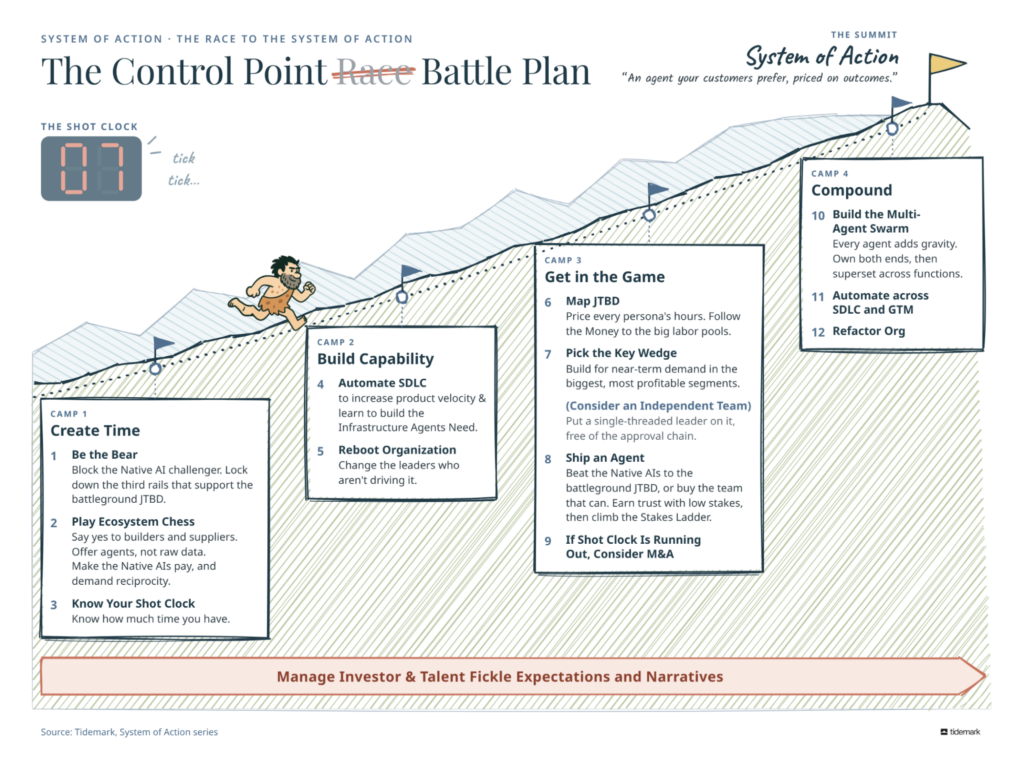
The Native AI Race Plan
Pick your market and your ocean, integrate and swarm, don't poke the bear, and know when to go for full replacement.

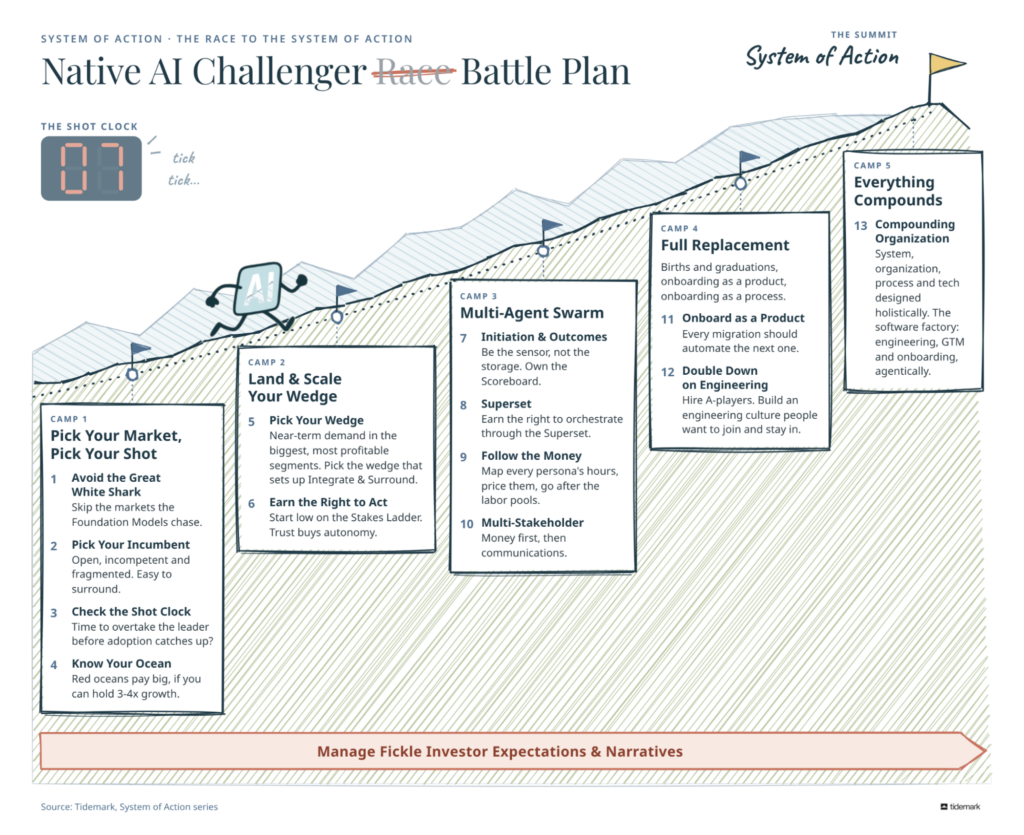
As a Native AI challenger, a startup purpose-built with AI for one industry, you are nimble. You get to pick your battle: the markets you pursue, the competitors you attack, and the methods to attack them. This is a bigger advantage than you might expect and will have real implications for the type of race you run.
Pick Your Market and Your Shot
We’ve covered in the past how to pick your market based on size and fragmentation. (If you’re starting a company, it’s worth reading our 2025 essay, updated in 2026).

Check the Shot Clock
Of course, an important factor is competition. If you’re not first, make sure you have enough time on the shot clock (the gap between the technology frontier and your industry’s adoption) to overtake the current leader. When you pick your market, you are picking your Foundation Model risk, incumbent threat, and competitive intensity.
Avoid the Great White Shark
Obviously, you should try to avoid the great white shark: the foundation models. They have billions of dollars of cash and trillions of equity value, world-class engineering, and global knowledge worker usage and mindshare.
That’s not to say you can’t succeed in industries the frontier labs are actively targeting, but it will get intense. Competitors will act irrationally, trying to outrace the labs, and VCs and talent will question you.
How do you avoid them? It’s pretty easy to understand where the labs are focused today, but how do you predict where they are going?
Outside of getting the latest thinking from friendly board members and executives, think about it structurally. Where is the TAM largest, where is adoption fastest, where is there strong product-market fit, and where do the foundation models lack the key components of the application layer (see System of Action Framework)?
Open and Incompetent Incumbents
You also get to pick your incumbent, the Control Point you’ll integrate with, depend on, and eventually surround (and maybe replace).
Pick an incompetent, open incumbent in a fragmented field.
Start with incompetence.
Find an incumbent that hits its customers with price increases and lives with low NPS. Find one whose products are legacy, built on years of platform debt, perhaps even still on-premise. Look for ones that are private equity-owned, with significant debt service, and can’t invest in product innovation. These incumbents can’t ship products, let alone agents.
Then look for ones that are open.
Look for platforms that let you integrate and steal gravities: read and write the data, work inside the workflow. Better yet, the platform monetizes its API. These fees hit your economics, but they also make API access a profit pool that is difficult for the platform to walk away from.
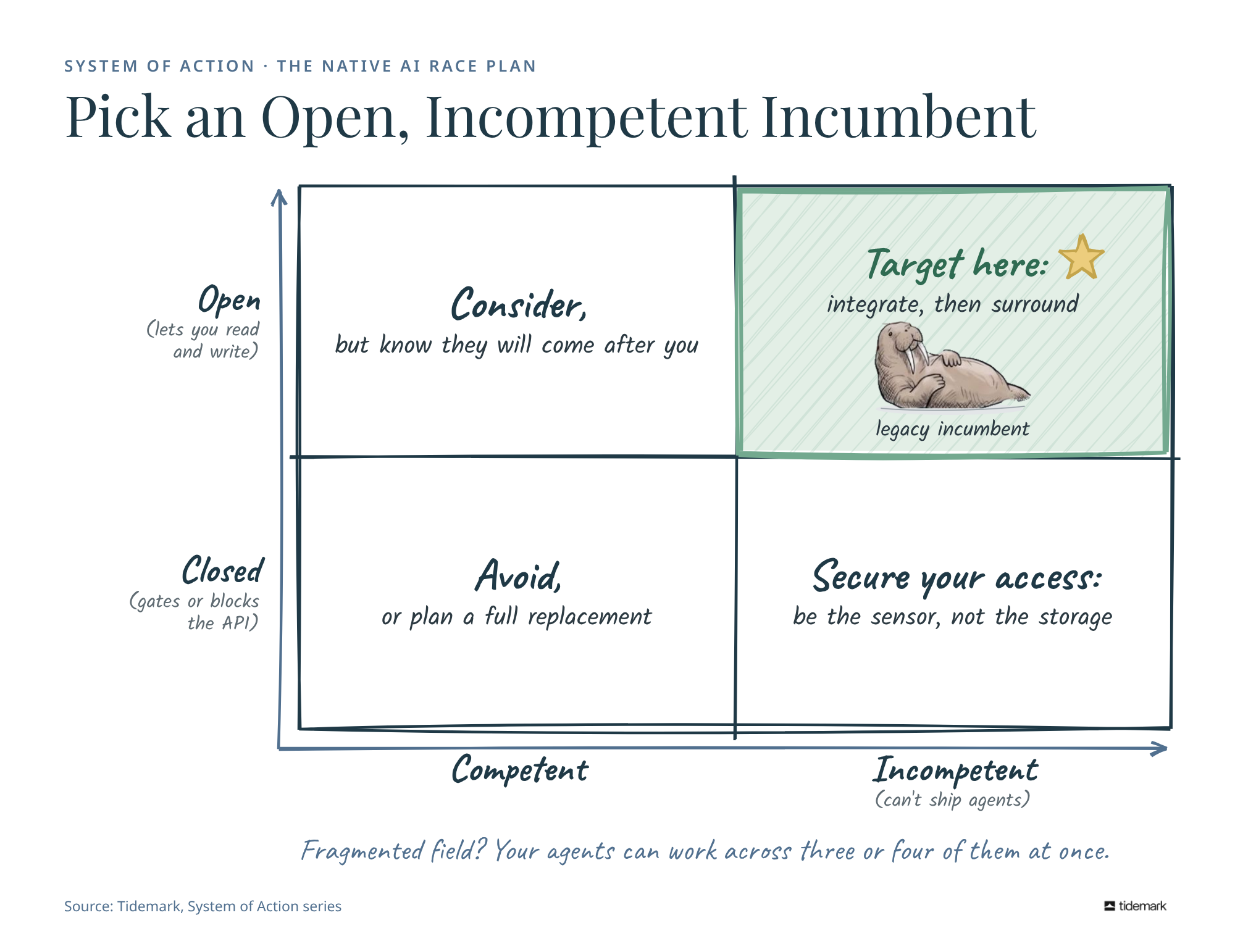
Finally, look for fragmentation among incumbents.
This is core to the integrate and surround strategy. Look for fragmented markets, where several Control Points split the share. No single platform can cut off your access, and your agents can work across three or four platforms at once, something none of the incumbents can do.
A great example is multifamily housing. The Control Point incumbents are Yardi, RealPage, Entrata, and AppFolio, and the two largest were built in the 1980s and 1990s. They rent API access at a steep price. Those steep prices didn’t stop EliseAI from integrating and building a large business on top of these property management systems (PMS). EliseAI hasn’t stopped at the wedge; it has now built its own PMS and is having strong early success replacing its PMS partners.
Red ocean or blue ocean.
You eat glass as an entrepreneur for the opportunity to build something that you believe should exist in the world, and make a lot of money at the same time.
The odds of winning this game are low, so go big! Might as well play a big game with big prizes.
That said, many of these large markets are becoming red oceans, and if you choose this path, you should know what you’re signing up for.
We’re seeing unprecedented competitive intensity right now. The setup is a handful of large, splashy Native AIs competing alongside their foundation model suppliers in an all-out race. Products are priced at negative gross margins to maintain share and produce massive growth, to justify massive future rounds at massive valuations. If you execute, you are rewarded handsomely with low-cost investor capital to keep going.
If you misstep, you’re f’d. Recently, I spoke on a panel with a group of experienced investors who concluded: “If you’re a Series B company growing only 3-4x, you’re unfundable.”
To be clear: We think 3x growth as the defining standard is nonsense and leads to a lot of false negatives. We at Tidemark don’t believe in this approach, and are open to investing in Native AI or Control Point companies growing 3x or less.)
But that’s the mentality many investors will have, so in reality, it is the bar you need to hit to stay on this train.
That specific strategy can make sense at first: the prize is enormous, and there is a credible path to economics with post-training, scale, and industry maturation. It is a highly risky strategy, but a rational one.
And then the VC super cycle kicks in. Bigger rounds mean bigger funds. Young partners (and old partners) “play the game on the field” (see Venky’s excellent post on reflexity) and are applauded for getting into splashy names. VCs scramble to push ever further out on the narrative risk curve, funding derivative plays at ever-higher valuations and lower performance thresholds.
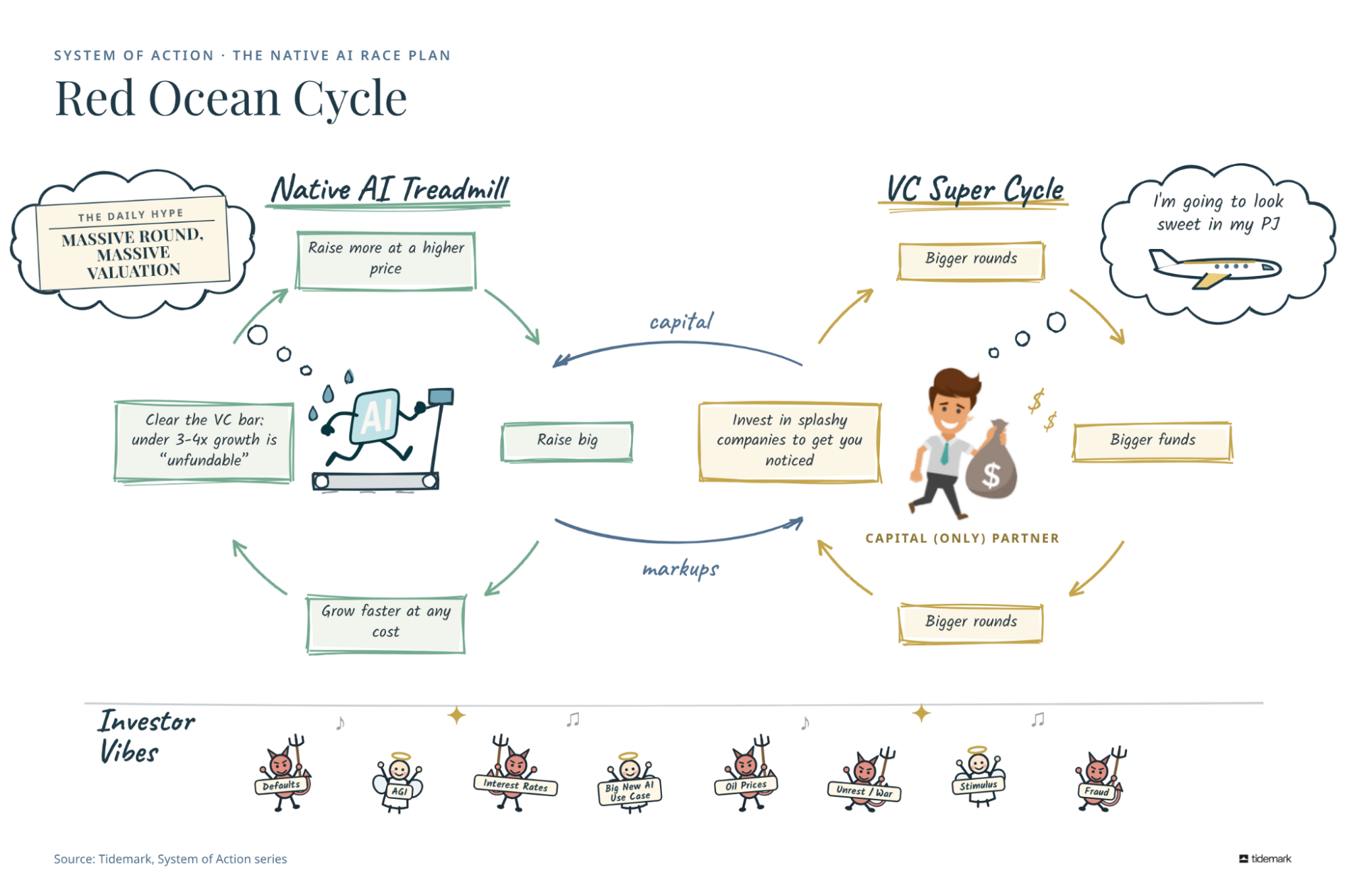
And then the narrative breaks. Maybe it’s a company collapse, a notable instance of fraud, or something seemingly esoteric or exogenous – interest rates, credit default swaps, or we decide to go to war. Whatever it is, the music stops, and you’re left with a cohort of otherwise great product companies without the financials to warrant further funding.
If you get out early, you’re set (which is a big deal!). If you have a path to margins to make an economic business, hello Bending Spoons, hello Constellation, please buy out our pref stack! If you don’t, hello dustbin! No one knows where we are in that cycle. But this cycle seems to be moving fast.
Putting on my grandpa hat, this was e-commerce in 2000. E-commerce was (and is) an enormous market, a magical value proposition, and a good business model. But the dot-com VC cycle (quaint compared with the AI cycle) led to poor behavior. Out of this capital wreckage, Mark Cuban got out early and is sitting pretty as the erstwhile owner of the Mavs. Jeff Bezos emerged with Amazon and is now a space adventurer with super biceps. The rest died a nameless death toiling on Pets.com, Webvan, Kozmo.com, et al. Read more of my grandpa thoughts on Spreadsheet vs. Story: Company building across cycles.
For what it’s worth, during that time I shot my shot in a red ocean market as one of the first employees of a startup providing ad-supported internet access. We grew to the world’s fifth-largest ISP in 18 months and were almost gross margin positive right as the ad market collapsed. I turned down Google to stay at the startup, and I cringe every time I see the company name on my resume (1stup.com, just an awful name). But man, was it insanely fun. I learned a ton and will never regret it.
TL;DR: Pick your shot; just know what you’re getting into!
Integrate and Surround Swarm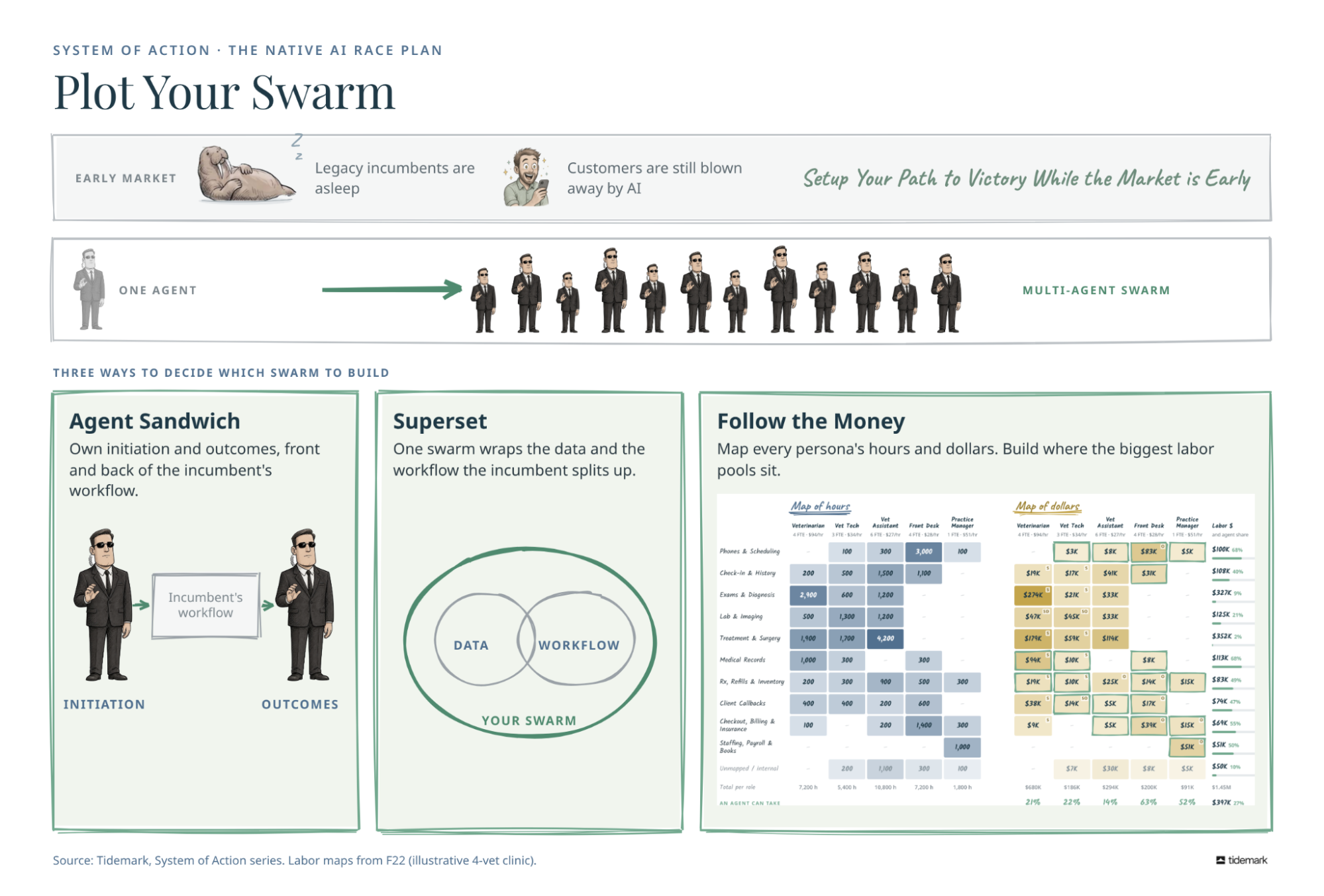
Most Native AIs choose to integrate and surround rather than go for a full replacement.
You start by building a compelling wedge, but the goal is to create a multi-agent swarm (see Multi-Agent in Winning the Race to the System of Action). So pick your wedge based on where you want to go.
These are the multi-agent swarms we see that can build a defensible moat:
Agent Sandwich: Initiation and Outcomes
You may eventually want to own the entire workflow, but you secure your destiny by owning initiation and outcomes.
Initiation.
Initiation is the moment work begins. Often that’s the front door, where the customer (and revenue) comes in. Sometimes it’s the critical decision that unleashes the workflow: approving a loan, allocating inventory, accepting a claim.
You are the initiator, the beginning of a workflow, and you can trigger downstream workflows. You are also often the sensor, not the storage (see Data Moats in What Customers Want). That way you own the data rather than getting cut off by someone else. And as the first agent in a workflow, you can sell the downstream agents really, really well (see Workflow Gravity in What Customers Want).
Outcomes.
If you are at the end of a workflow or just store the outcomes, you have valuable data to drive the learning loop that helps agents get better over time.
Even if you don’t want to price to outcomes, you have the data to speak to the outcomes and business impact your agents deliver.
As one Native AI CEO put it:
“The customer data is theirs (the incumbent platform), but the traces — everything they do on the platform — belong to us… the traces are the gas that’s necessary for this car to run…”
– Native AI CEO
Superset: Data and Workflows
Build what the Control Point incumbent can’t match! Superset them by pulling input data and context, and actioning workflows from multiple incumbents. Because you control data, context, and workflows across incumbents, you offer what each does well, plus the cross-platform view they can’t have.
Data.
Hoover up all the data around the job, from every System of Record that touches it, every point solution, and third-party industry data. Then turn it into the Operational Artifact that drives the answer and triggers action.
The artifact is how your customer thinks about her business, and it gives her all she needs to make a decision. For example, a contractor runs her jobs off the WIP report, which tells her which jobs are making money and which are over-billed (see Adaptive Case Study in the Data Gravity essay).
We wrote All the Data to warn Control Points that a Native AI would do exactly this, so take it as your playbook.
Workflow.
Earn the right to orchestrate (see Workflow Gravity in What Customers Want), then orchestrate tasks across multiple systems you don’t own, so each incumbent becomes a nameless tool call for your agent.
Aim at the jobs that span several systems, and do what no single incumbent can.
Follow the Money
And of course, go after the big pools of labor, and therefore dollars, you can price to (see: Operationalize “Doing the Work” in Winning the Race to the System of Action). If you make 3x what the software vendor makes from a customer, you’re more important to that account and can spend more to keep it.
Watching these three strategies come together into specific product and business archetypes over the past 18 months has been incredible. We’ll share write-ups of the archetypes we’re seeing in the real world in subsequent essays.
Don’t Poke the Bear
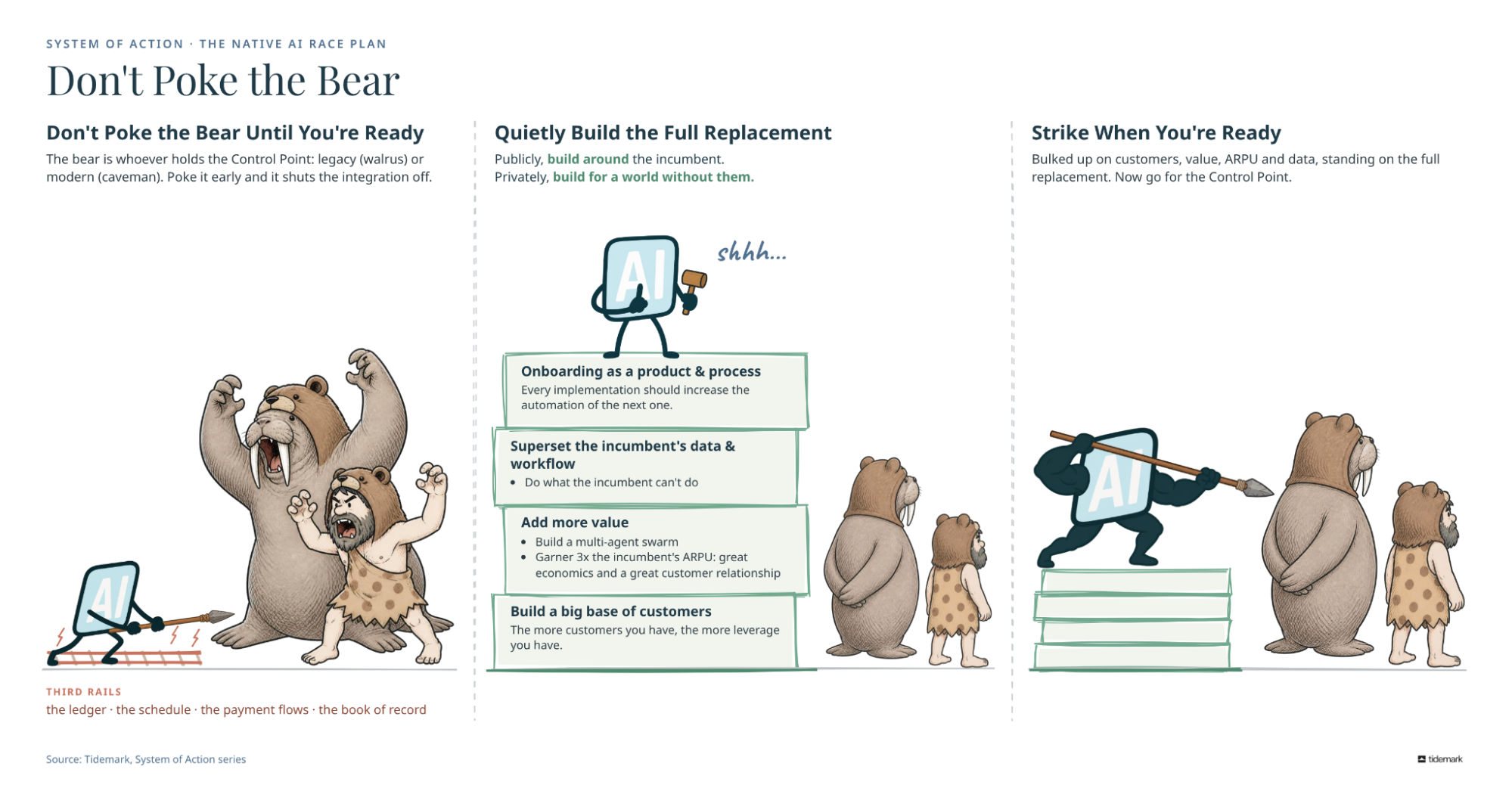
It may be uncomfortable to admit in public, but you are in conflict with the Control Point incumbent. You know it, they know it. And it’s super uncomfortable because you depend on them. At any moment, it can shut the integration off and make life very hard for you and your customers.
Avoid the temptation to pick a fight. Live in cooperation as long as you can. An aggressive Control Point is going to create risk for potential customers, investors, and employees. Wait as long as you can to have that fight. The more customers you have, the more leverage you have.
Avoid Third Rails.
Know the incumbent’s motivations and sensitive spots. The Control Point wants partners to enrich its ecosystem, and good platforms are explicit about what they intend to own and what they cede to partners.
But some don’t announce this publicly, or, worse yet, are intentionally misleading. You really need to know what they hold dear.
For the ERP, it’s often the ledger; for project management, the schedule; for point of sale, the payment flows. For the agency management system, the book of record and the money that moves through it. These are the third rails that may trigger a confrontation you’re not ready for.
Secure Your Access
If you aren’t fortunate enough to benefit from regulation (as with some EHRs), think through ways you can secure your access.
Tactics like computer use and RPA can work in the short term. But structurally, you want to be the sensor, not the storage. Own the data ingestion, digitizing data that lives in binders and employees’ heads.
Ultimately, security comes from the value you bring. You want the Operational Artifact that delivers the most value for your customers, e.g., the WIP report above.
How can you tell what’s most valuable? Most of the time it’s obvious. If not, look for customers going through hassle (e.g., downloading CSVs from the incumbent) to build that artifact, so your agent can act.
Publicly, build around the incumbent. Privately, build the multi-agent swarms described above to secure the high ground.
If you think you’re ultimately going to war with the incumbent, build for a world without them. Quietly build their key primitives. Superset the incumbent on data and workflows (see Integrate and Surround): go deeper with operational data or broader across functional areas.
Do everything you can to not go frontal – i.e., full replacement. Even as you near replacement, don’t build a one-for-one replacement. Build something different (something better). Build something not possible without AI magic. Language and positioning matter. You’re not building a better ERP or a better agency management system. You’re building an application to do the work the old primitive was never asked to do.
None of this is an argument for going slow. Run the race plan at full speed. But don’t poke the bear until you’re ready.
Full Replacement
“Sitting on top of these vertical systems… that’s like a suicide mission, because eventually they will eat your lunch or they will cut you off.”
– Eric Rea, CEO of Podium
It’s hard to generalize; most Native AIs really are on a collision course with the Control Point incumbent. You need to seriously consider a replacement strategy.
When to replace.
In some instances, you may never need to replace the Control Point incumbents. A PE-owned incumbent may stay fat and happy collecting your API fees while your agents make its platform stickier. Your enterprise customers may have built the platform in-house or customized it so heavily that it’s basically custom software. The incumbent could be on-premise and unable to block you. The incumbent may be legally prevented from blocking you. Or the incumbent may be so entrenched that replacing it is just impractical.
But we think in most situations, collision is the natural course. The labor budget is the big opportunity, and as that becomes clearer, an incumbent is unlikely to give up that prize.
How to replace.
Replacement is hard. Control Points are hard to onboard and hard to rip out, because of data, workflow, and account gravity.
Rillet’s own team calls the full replacement path “grueling.” One Native AI that just started pushing the full platform replacement up front (vs. a point agent) saw win rates immediately drop from 39% to 10%.
So catch customers during birth and graduation: when they have no system or have decided they need a new one. Rillet’s first customers were mostly QuickBooks graduations, companies that had outgrown their books and had to pick an ERP.
Encourage graduation by nailing the specific functionality that makes a graduation worthwhile: multi-location, complex inventory or labor models, enterprise edge cases, practice-area depth, and payer automation. For one Rillet CFO, the driver was “speed to close,” ahead of multi-currency or multi-entity, and Rillet sold revenue recognition at the push of a button.
Onboard as a product.
Build onboarding into your product: a semantic layer on your side, and LLMs that match the incumbent’s fields to yours. Aspen, the new CRM inside Veeva, features a semantic layer in code. The metadata lives in Git, compiled and validated, basically code, so agents can read your old CRM and map it to the new one. Aspen promises a two-hour onboarding. Then it puts agents to work on the inevitable administrative cleanup that any migration kicks up. Aspen’s first agent dedupes contacts, which removes 80% to 90% of that burden.
You only control one side of it.
How hard this gets depends on the incumbent’s taxonomy. In SMB it’s easy. QuickBooks is close to 100% standard fields. Digits, an AI-native accounting platform, shared that they can switch a customer off QuickBooks in five to ten minutes: “All they do is link their QuickBooks account…There is no implementation.” An EHR with 80% custom fields is a lot harder.
Productize the onboarding process.
In the enterprise, that means forward-deployed engineers. Many Native AI CEOs cite deploying someone on-site as “the only way to change these big enterprises,” more “a catalyst for change” than an implementer.
Give your customers a parallel path before a hard cutover. Or give them a way back. Accounting firms moving to Digits asked to keep writing back to QuickBooks in case Digits failed. A safe exit lowers the risk of the switch.
In SMB, Podium runs migrations with scrapers and computer-use agents logging in on the customer’s behalf, backed by a manual team offshore, and targets 48 hours.
Finally, onboarding should get easier over time. Every implementation should increase the automation of the next one.
Press your Engineering Advantage
Like all startups, you win on speed and execution, and what you generally bring to the race is engineering. Double down on it.
Hiring is super competitive, but A players hire A players, and B players hire Cs. So do what it takes to find an A, and build an engineering culture people want to join and stay. Everyone is scouting for the same credentials, so create a pipeline of talent that over-indexes on agency, drive, and time-on-task rather than resume.
In late 2026, the harness and context layer win – keep moving it forward. Post-training your own model (see Own Your Intelligence) is where you can get independence from the foundation models and separate on accuracy, latency, and cost. Post-training will become table stakes, and the sooner you get there, the more learning you compound.
Finally, speed is your advantage, and product velocity is how it shows. So keep pushing the limits of automation in your SDLC.
Everything Compounds
Products (What Customers Want) compound with engineering and infrastructure (What Agents Need) to build moats.
Onboarding compounds: every customer you onboard brings in that client’s specific context, which improves that client’s agents. It also brings in industry ontologies and best practices that improve agents for all of your clients. Engineering is increasingly connected to marketing, sales, and support, and to the GTM systems behind them (h/t my partner Rocky Gowni and his Getting to the Software Factory). The more you link these business functions and systems, the faster your company moves.
Bumping it up a level, external and internal functions are rapidly blurring, connecting, and compounding.
As a Native AI challenger, you get to define everything (systems, functions, roles, capabilities, compensation models, and culture) bespoke to this reality. This might be your long-term competitive advantage; keep pushing it.