The Control Point Race Plan
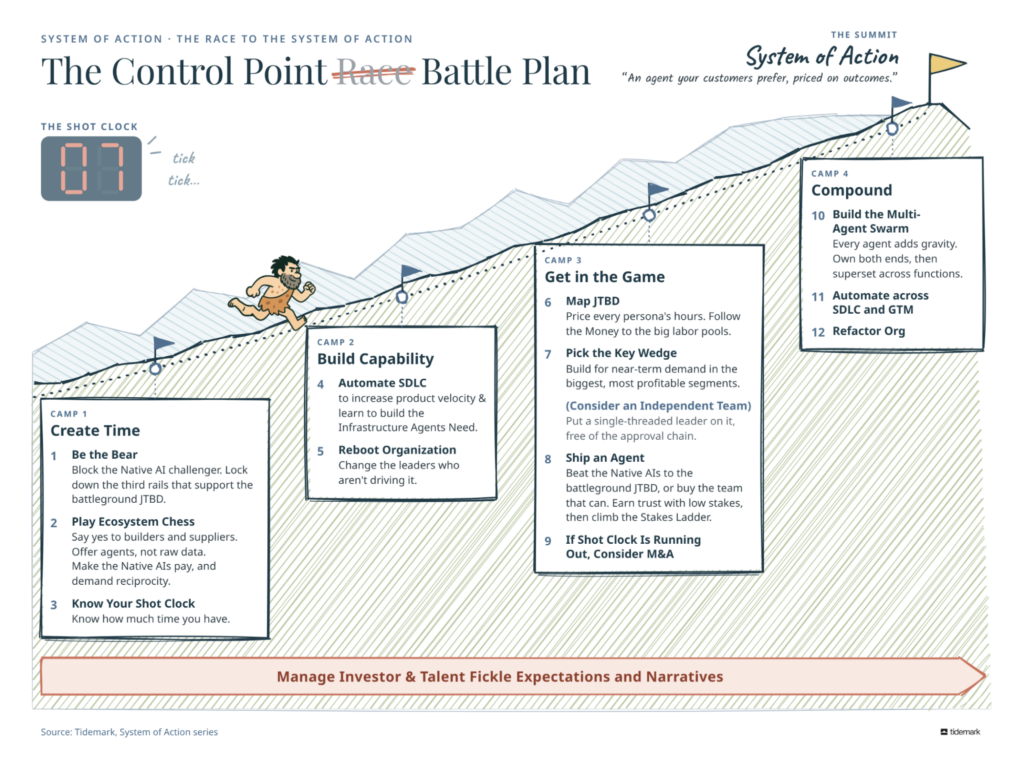
Get in the game, lock down the third rails, play ecosystem chess, and reboot engineering before the shot clock runs out.

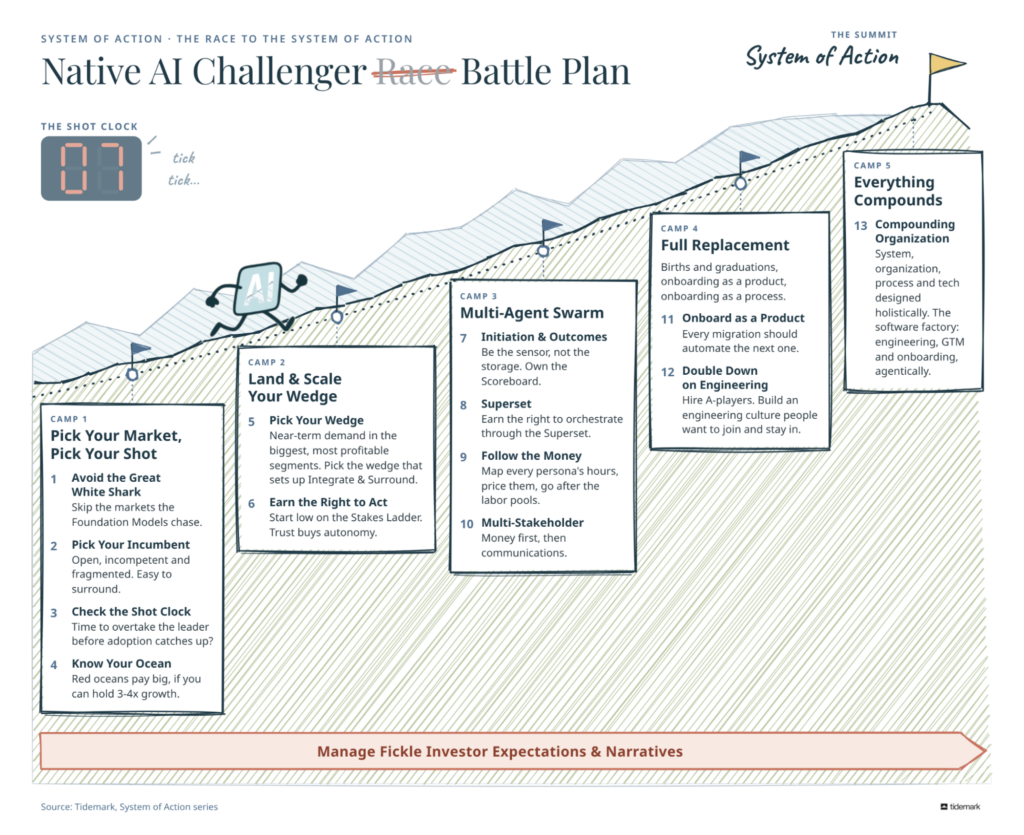
In Tools for Hero Users & Replacing Cousin Richie, we speculated how Native AI challengers would attack. Part 3 (Race to the Agentic Future!), we declared, “It’s on like Donkey Kong!”
Now we’re in the thick of it, and the throwdowns between Native AI challengers and Control Point incumbents are playing out before our eyes.
Most markets are moving through three stages of adoption. In early markets, customers are open to accepting an inferior AI product embedded in their Control Point. In maturing markets, the bar is 80% of the best-of-breed (see Case for the Application Layer). In mature markets, customers will demand parity, or maybe even a superior product.
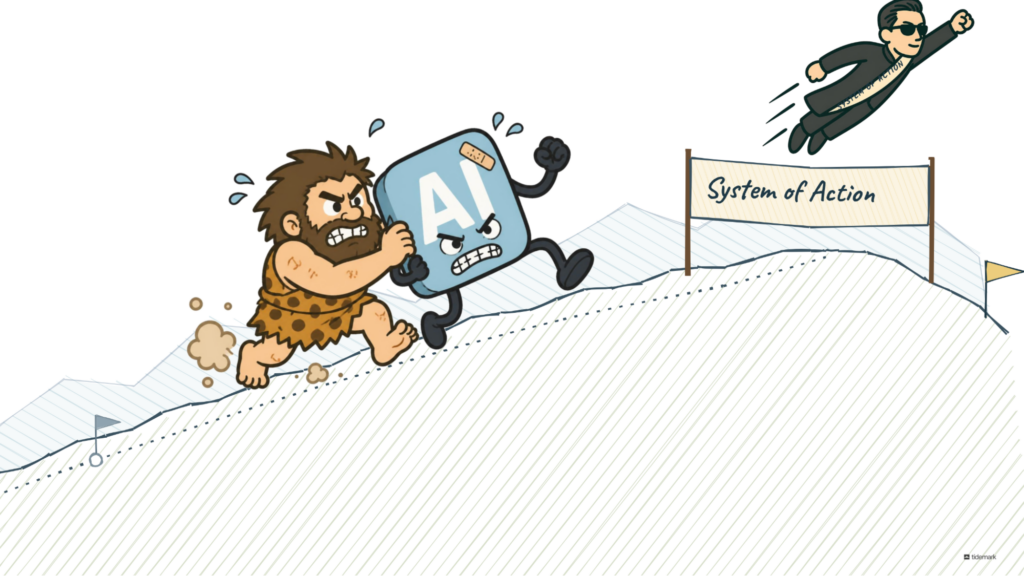
So, you, the Control Points, are on the shot clock! The next few years (and months) will determine whether you can defend your position and participate in the agentic future.
Get in the Game
You come to the starting line with brand, trust, distribution, customer depth, and tribal knowledge. You have UIs built for humans and the domain, broad deterministic workflows, adjacent context on how the business runs, and the ability to verify outcomes.
Great, but you need to get in the agentic game!
If you haven’t already, get in the conversation and set your vision for the future, even if it’s just aggregating current industry views (see Own the Narrative in Winning the Race).
More importantly, you need a product in-market yesterday. You need it not only to secure the high ground, but also to win your customers’ trust as an innovation partner.
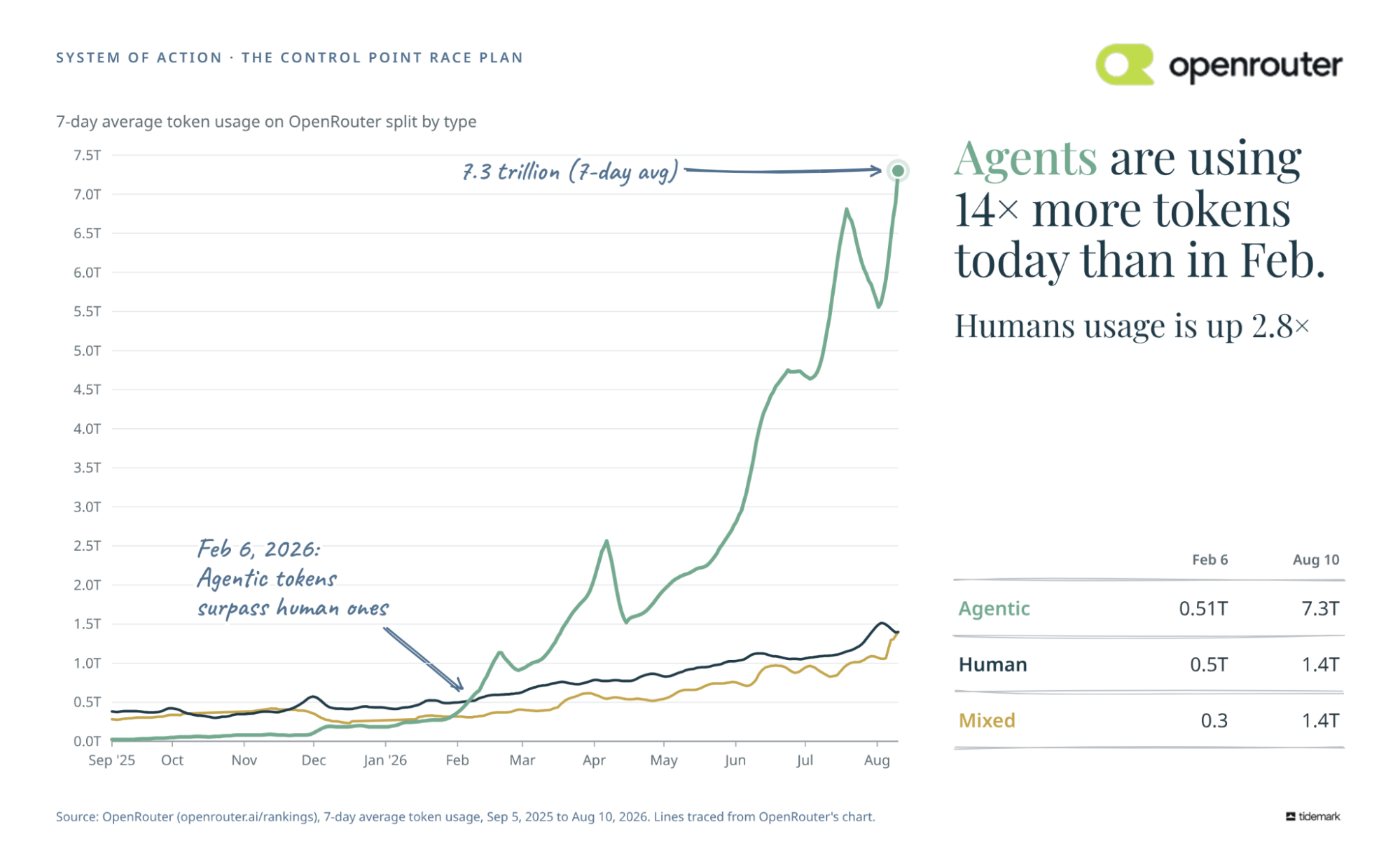
And we’re not talking about performative AI demos for your board, or co-pilots that are helpful but no one will pay for. We mean agents that automate specific, high-value jobs to be done (JTBD) for specific personas, because that’s where the money is. The world has moved on from co-pilots.
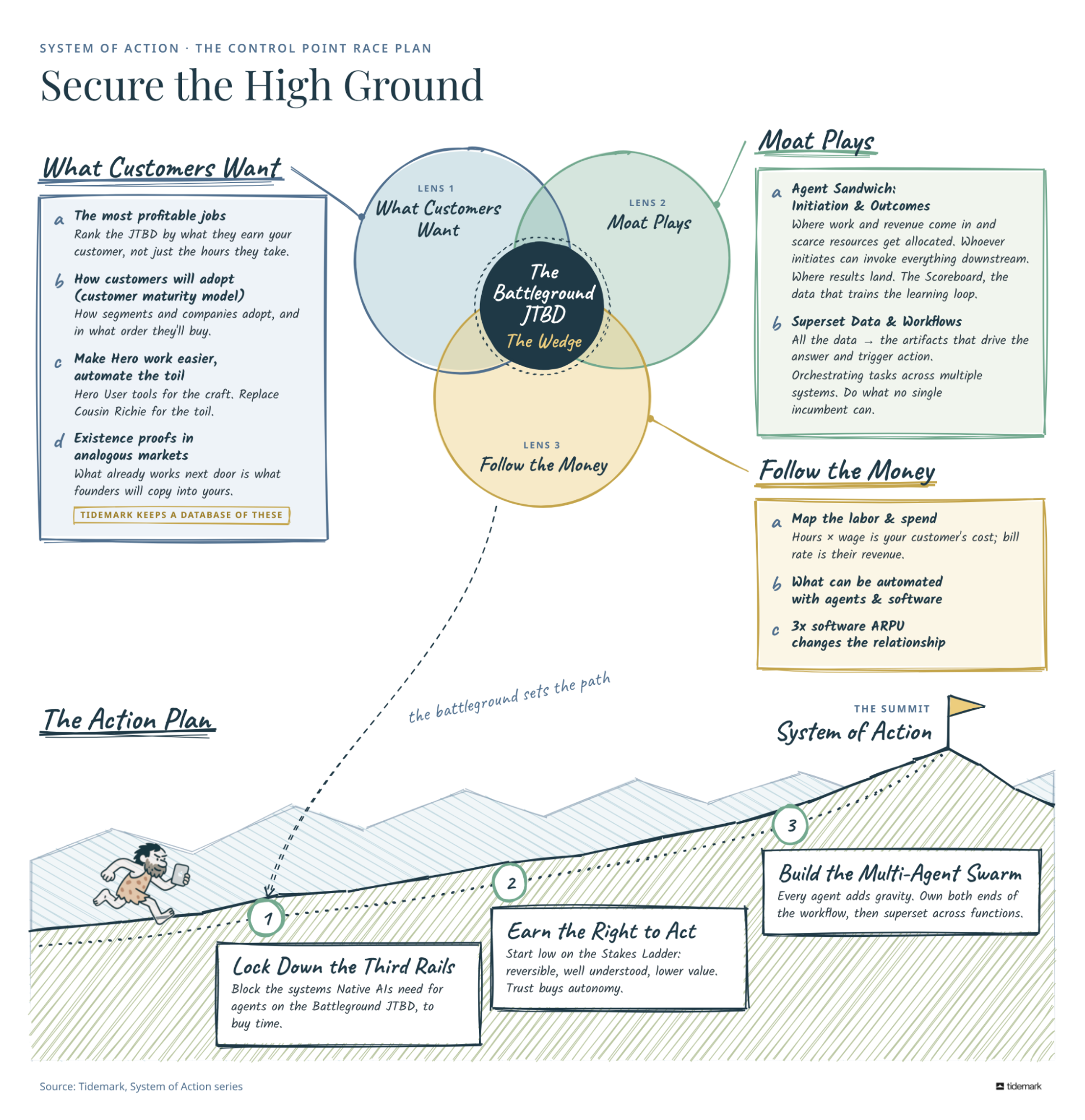
Secure the High Ground
In Winning the Race to the System of Action, we laid out how to find the most important JTBD in your industry. In the Native AI Race Plan, we predicted where the Native AIs will attack: distinct wedges that grow into multi-agent swarms (see Integrate and Surround). These are likely the same JTBD you should target.
These JTBD are the battleground, so marshal the resources to head the Native AIs off, either by beating them to the wedge or by building a competing offering that keeps them from getting too much traction.
(If your roadmap isn’t at that level of specificity, if “AI” and “agents” show up in it as catch-alls, or if you’re building a wide range of convenience features, you’re in trouble. It’s time to step in as the CEO.)
Part of marshaling resources is M&A. If you know what the high ground is, and you can acquire even an early team with great engineering, you can’t afford not to chase it hard.
Create Time
Know your third rails.
Third rails are what you hold dear and don’t want to share with others. Sometimes it’s about monetization and business model (e.g., most vertical SaaS sees payments as intrinsic to its business model and product).
Increasingly, it’s the systems agents need to do those high-value JTBD. For example, initiation is a common battleground JTBD. The inbound receptionist is the agent, and the systems it runs on (your phone system, online booking and ordering, and client intake) are the third rails.
Lock down the third rails that support the battleground JTBD
If you know where the threat is coming from and where the high ground is, lock it down. You may get flogged online and damage customer trust, but you’re in an existential battle, and you need to do what it takes. Communicate a credible roadmap and timeline to your customers, and a vision for why your offerings will superset the point solution.
Play ecosystem chess
While we’re arguing for strong action in the key battleground JTBD, we’re not arguing for complete isolation. As a Control Point, you are “born multi-product,” which makes you a natural platform. Third-party partners enrich your platform and add to your gravity, even as they compete with you.
Get the defense right, and you’ll build a healthy ecosystem while slowing your most pernicious competitors. Get it wrong, and you’ve lost your Control Point or pushed your customers to your competitor.
Here’s how we think about it.
Match Your Defense to the Shot Clock
How hard you defend depends on where your market is on adoption, and how much time you have on the shot clock.
In an early market:
Customers are experimenting with agents more than they need them, and the integration rarely comes up in RFPs or renewals. The earlier you are, the more expansively you can define your third rails, and the more you can straight-up block external access to them.
This may trigger Native AIs to turn to a full replacement strategy, but that can give you more time to secure the high ground yourself. The comms should be authentic: security concerns, data privacy, plus “our offering is coming.”
In a maturing market:
Customers believe they need agents, and the integration starts showing up in RFPs and renewal conversations. Blocking now costs you NPS and can hand the challenger its marketing.
Beware: Podium booked 300 demos the day ServiceTitan announced shutting Podium off. Slow threatening partners down instead (see Design the MCP and Tax the Native AIs).
In a mature market:
A meaningful share of your customers already pay for the point solution, and they’ll keep both if both add value. Blocking puts the customer at risk.
Know Who’s Asking
Native AI point solutions are looking to surround and replace you. But plenty of asks are easy to say yes to:
Large customers or private equity firms who want to build on you?
Awesome. Even better, large systems integrators. You become their platform for agentic development (see Build UIs for builders in Account Gravity). And Claude is training customers to pay on a usage basis.
Consumer agents are coming too.
AI assistants that act on behalf of consumers, like Meta’s Muse and Instinct, already drive a meaningful share of activity in some industries.
For example, Google recently asked a Control Point for a catalog API that pre-caches all of its availability so Google’s agent can book directly. You probably can’t block these agents, and you don’t want to. Connecting brings in revenue, defends your merchants’ interests, and, if you own payments, gets monetized (see Sell-side agents in Account Gravity).
Suppliers deserve a bit more consideration.
Your merchants are sending them money, which gives you an opening to offer agents to suppliers as well (see Supplier Extensions).
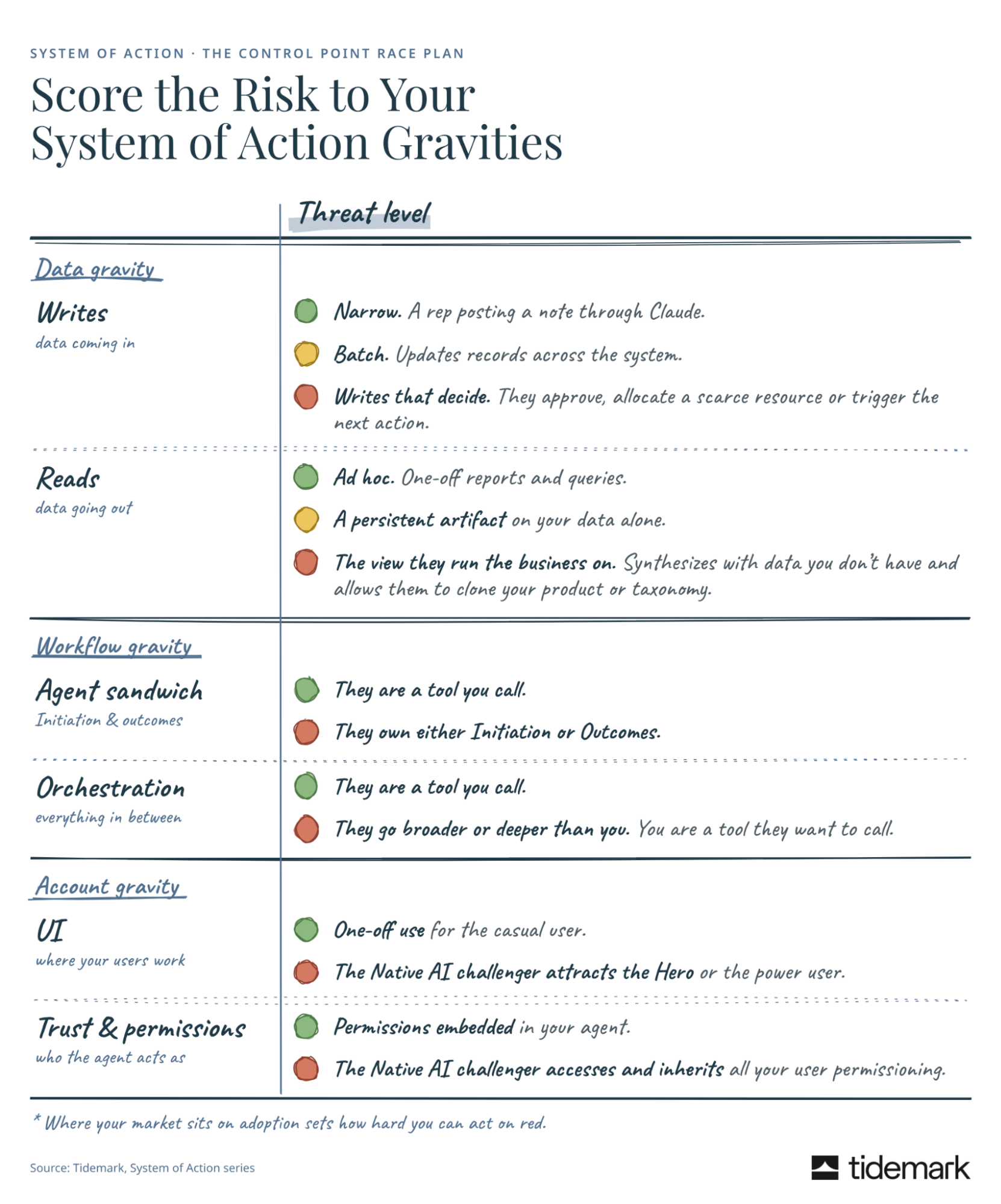
Score the risk to your System of Action gravities.
Opening the door to Native AI point solutions is a tougher call than opening the door to agents. You can’t manage each one individually and keep a healthy ecosystem, so score each JTBD category by its risk to your System of Action gravities.
Data gravity writes and reads.
For writes, scope matters. A rep logging a CRM note through another agent is low risk; it adds to your data gravity. A write to fields that make the key decision, release a scarce resource, or trigger an action is high risk. In freight, a TMS update books a contract and sets off voice agents calling carriers. Now the agent is the initiator, and you’re its tool.
For reads, scale matters. A one-off query is low risk. A persistent Operational Artifact (the report or view your customer runs the business on) is high risk, because it becomes their UI for decisions and actions. (We argued in All the Data that owning the reporting layer secures account control.) If it runs only on your data, you can out-build it. If it aggregates other data (including your competitors’ who won’t play ball), it gets tricky.
Also avoid comprehensive reads, as they can expose your metadata and taxonomy, making your product easier to clone and your accounts easier to switch.
Workflow gravity.
Think of the job as a sandwich. The two slices of bread are initiation (where the job starts) and the outcome (what happens in the real world). Your risk level depends on whether you’re the filling in the sandwich.
You’re low risk if you initiate the job and own the outcome. You’re medium risk if they own one end. You’re at high risk when the Native AI challenger owns the initiation and the outcome. You become the filling for their agent sandwich.
There’s another risk shape to consider. When Native AI challenger agents run a job across you, other Control Points, and third parties, you are in a precarious position. Now they’re the orchestrator, they’ve supersetted you, and they hold outcome data you can’t access.
Account gravity.
Account gravity is your UI and the trust and permissions customers grant you.
Fight for your UI with powerful and influential users; losing them is high risk. Casual users who want quick-and-dirty data entry or chat Q&A are low risk, a fight you can let go. But watch the apps they and others adopt, then copy them and build a superset – an ecosystem of context, action, or data around those apps that works across them.
On permissions, permissions embedded in your agent are lower risk. But giving a Native AI challenger direct access is high risk, hard no.
Pragmatically, your partner strategies will shift, and, as a Control Point, you manage tens or even hundreds of partners. You can’t keep track of it all.
In an early market, play conservatively on access and build controls and flexibility for yourself into your partnership docs. As the market matures, staff up here with people and automation for recurring monitoring.
Also build process and product safeguards into your platform ahead of advances in RPA and computer use (e.g., a second sign-off on writes that can trigger big actions). This can add user friction, but on high-value, high-stakes JTBD, it’s a no-regrets move for both platform control and customer safety.
Design the MCP and Tax the Native AIs
When you open up, offer agents – not raw data or workflows. Your levers are data versioning; read, not write; one-time versus time series; and the level of aggregation. Treat an agent like any other user role, with permission controls to match.
Tax Native AIs.
Your installed base is the distribution a Native AI challenger can’t buy. Integration is product elegance, so make them pay for it. Native AIs are already struggling with gross margins, so add one more line to their COGS.
Demand Reciprocity
When a Native AI asks for access, flip the ask.
Filevine’s version goes something like this: “Okay, sure, but of course it goes both ways, correct?”
If they want your data and your write path, you want their traces, their outputs, their context. It evens out the give/get and helps you provide a better product for your customer. Most won’t agree, and how they answer tells you whether you’re dealing with a partner or a challenger.
Every one of these tactics buys you time. The clock is the challenger’s land-and-expand, and the only thing that stops it is an agent your customers prefer, priced on outcomes. Building that agent starts with rebooting your engineering team.
Reboot Engineering, Transform the Organization
Every clause above adds to a product and engineering queue that is already overflowing. But focusing on securing the high ground means deprecating lesser priorities.
Even with that focus, a Control Point needs to significantly ramp its product velocity, and that means automating its SDLC.
My partner Rocky Gowni wrote an excellent roadmap for automating engineering, product, and design, and then extending into commercialization (see Getting to the Software Factory). And he will be going deep on this at Collective Live.
So we will leave this point other than to say this is the moment to take a hard look at your leaders. This is an existential battle, and you can’t do it on your own.
Tidemark also has a hands-on “Build it With Me” engineering offering to work with portfolio companies and high-priority prospects to make the agentic transition. Reach out to [email protected] if you’re interested.
Put a Single-Threaded Leader on the Battleground JTBD
It may be a long time until you can transform your org and systems into a more competitive operating model.
Don’t wait for that transformation or let it get in the way of securing the high ground.
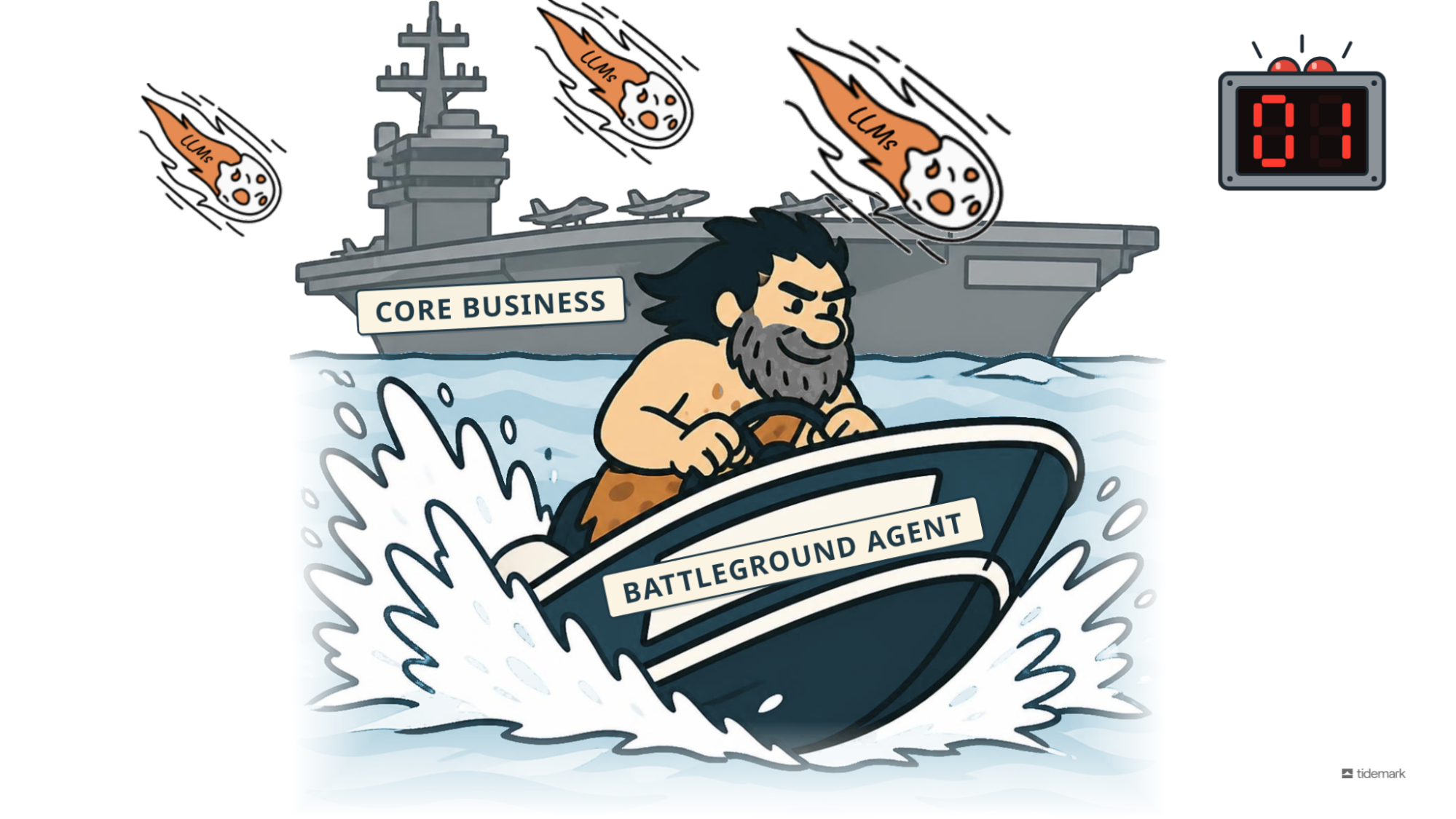
Pick your most talented engineer, PM, or designer and let them run it with a small team, free of the roadmap and the approval chain. Overstaff platform resources to work through rickety infrastructure. If you don’t have a standard harness, let them take the best one and build it to their needs. Give them GTM resources so they can access your customer base. Give them what they need to move as quickly as your Native AI competitors. And think about how you might fold them back into the organization over time.
You don’t need to blow up your org chart day 1, but you need to find a way to let your most talented folks run ahead.
Parting Thoughts on Race Plans
AI needs an application layer, and it’s a 10x opportunity if you win the race to build the System of Action your customers will soon demand.
The stakes are high, but the course is also unforgiving.
Gravities compound. Account gravity earns the permission. The permission triggers the workflow and the data. The workflow generates the outcomes. The outcomes train the intelligence. And the intelligence makes the next agent better than anything a challenger can field — which earns more account gravity, and around it goes.
It also doesn’t stop at one agent. That agent does downstream work that builds the next agent.
That is a winner-take-most structure, and in some markets it will look a lot like winner-take-all. A Native AI CEO said it well:
“If I’m the initiator. If I’m the ground truth these agents have to run on. If every day my customers are teaching me more about how the industry works and how it’s structured — I don’t have an unfair right to sell the next product. I have the only right.”
Are you going to be the application layer that brings AI to your customers? Are you going to win??
The race is on. Run.