Replacing Cousin Richie
Important jobs done poorly or not at all, and why an agent priced against Richie beats software pricing.


Meet Cousin Ritchie. We love him, but he’s really dragging down The Original Beef’s potential.
It’s not Cousin Ritchie’s fault. While Carmy is busy in the kitchen, Richie is the fill-in-the-gaps guy. He’s the line cook, the front of house, the emergency electrician, and the accountant. He’s good at some of this, but he’s bad at most of it. And deep down, he knows it.
Every business has a cousin Richie. Someone who is doing too many jobs poorly or not at all. This is one of the most powerful wedges in the Native AI world, and it comes down to this: Replace the jobs Richie hates.
It’s good for Richie (he hated accounting anyway). And it’s great for you, because you get to price relative to Richie, not the back-office software. And it’s good for the business because the agent is going to do the job better than Richie ever would.
Here’s how you do it:
Winning Without a Hero User
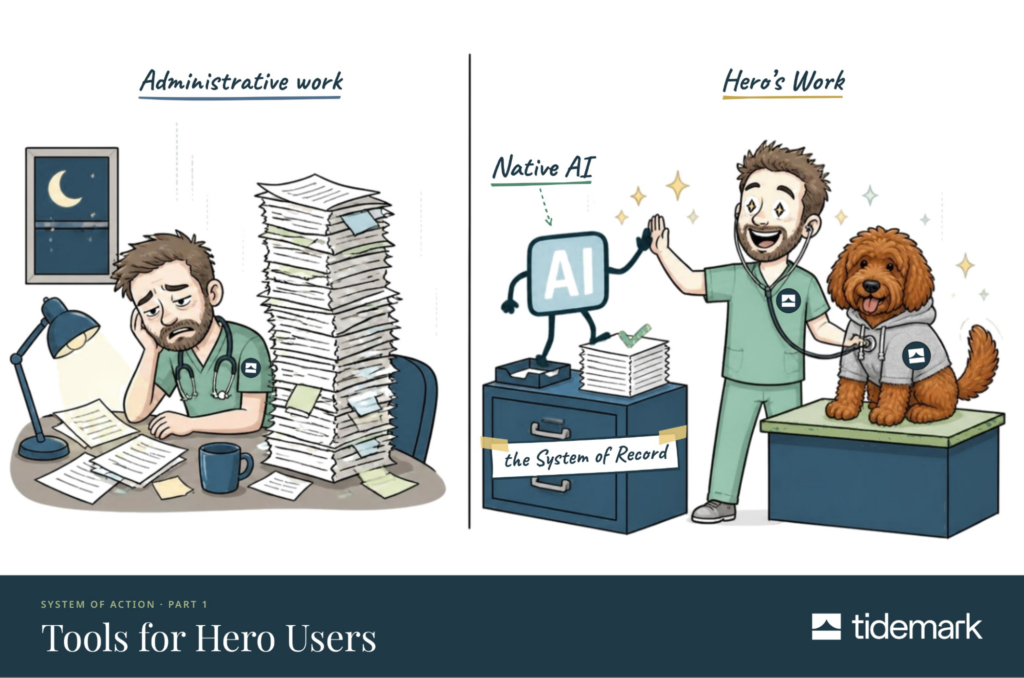
To become the System of Action, a Native AI needs a wedge. One path, covered in Tools for Hero Users, creates a wedge by targeting the Hero user who has agency to choose her own software.
But what if no hero user can choose their own software? What if the person doing the work is stuck using tools chosen by someone else?
Most workers don’t get to choose their tools. No matter how good the chef, if he doesn’t own the restaurant, he’s not picking the POS. The superstar insurance rep crushing her quotas every month is not picking the CRM.
So, how does a Native AI dislodge the Control Point when there is no hero user? You target the “Cousin Richie” problems. The stuff that the business owner doesn’t want to deal with, so she piles it on to someone else.

“Cousin Richie Problems”
Some of the best problems to target are what I call “Cousin Richie” problems.
In today’s age, Cousin Richies can take a number of forms. The offshore call center, the freelance bookkeeper, or that local marketing agency turning out low-value newsletters.
If any of the tasks you identified above — setting sales appointments, renewing accounts with tiny customers — are in Cousin Richie’s hands, guess what? You’re in luck!
Why? Because AI runs circles around Cousin Richie.

AI never shows up late, forgets its login, and spends half the day vaping out back. AI works 24/7, speaks 40 languages, and is infinitely coachable. It never forgets, never loses its cool, and is always 100% focused on whatever you want it to be.
And because your AI runs circles around Cousin Richie, you should be able to charge a price that is a fraction of the cost of Cousin Richie, but still 2-5x the cost of the control point software.
Finding Richie Problems
Once you start looking for Richie Problems, you’ll see them everywhere. These are the tasks that don’t live neatly in one role or system. They require coordination, negotiation, iteration, and constant judgment calls. You’ll find them buried in invoices, contracts, design sketches, inboxes, voicemails, and yes, still occasional faxes. They’re the problems that get “talked out” on the phone. They’re just hard to automate because they cross teams, departments, and even companies. They’re always moving, always messy, and never resolved the same way twice.
Here are some obvious places to look:
- Phone-based communication: They suck and should be reserved for critical, time-sensitive matters. It’s a great place to start, and our friends at Euclid have laid out a great thesis here. Any phone-initiated process warrants a hard look.
- Complex orders, RFPs, RFQs, renewals, change orders, or multi-party quoting: This requires producing, reading, understanding, redlining, and managing version control on 100-page documents. Humans are bad at this; AIs are purpose-built.
- Fragmented workflows or supply chains with unpredictable exceptions or multiple layers of approvals.
- Mo’ people, mo’ hassle: Any endeavor that involves multiple people or stakeholders.
AI doesn’t replace the person, at least not at first. It rides shotgun, nudging, guiding, and unblocking. All the while, it learns context, cadence, and the informal, real-world rules of how work gets done.
The next level to this is finding the places where AI fills gaps. That’s the work that never gets done at all.
This is GenAI’s stealth power: tackling jobs too expensive or too tedious for humans. In smaller businesses, these critical tasks are the first to fall through the cracks. Calls go unanswered, pricing gets stale, and supplier decisions default to “whatever’s easiest.”
When the pain becomes too great, they get outsourced to marketing agencies, procurement firms, lawyers, accountants, and various consultants, all billing $400 an hour. They’re perfect targets for agentic solutions. In this world, agents become the new agencies.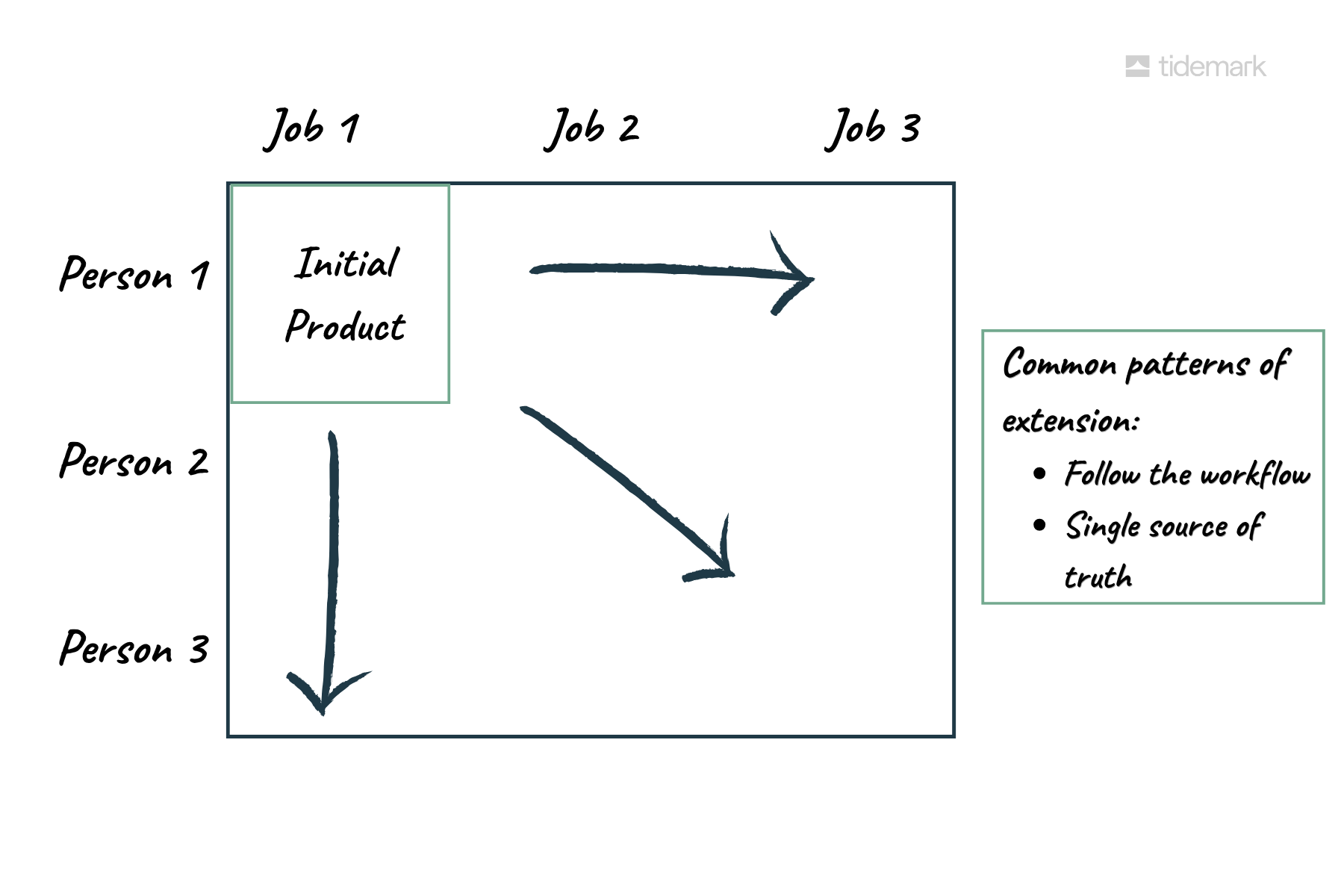
Value Road Map
On the path to supremacy, expect a fight. The incumbent won’t go quietly once they realize what you’re up to. The stakes are survival, and it’s exactly what they should do.
Customers will be tempted by their offer. Who wouldn’t choose to stick with their existing software that is fully integrated with all their workflow, data, and account ownership gravity? When inertia feels seamless, switching seems risky.
That’s why you need a value roadmap, one that puts real distance between you and the incumbent. While they’re busy copying your first product, you’re shipping the second and building a third. While they match your features, you’re expanding into new capabilities, new personas, and deepening your strategic relevance.
Here’s how you make one:
On one axis, lay out the “Richie jobs” that are adjacent to the job your initial product serves. Likewise, on the other axis, put adjacent personas to the target persona that your initial product serves.
Each new product either does an adjacent job, serves an adjacent persona, or ideally both. When you consider the next new product, think through the frameworks we’ve discussed in the past (see Control Point Patterns 2024, Platforms of Compounding Greatness).
What you’re laying out is the roadmap to how you’re going to extend your product portfolio to do more jobs and to add more value to more people in the organization. That’s the key to locking yourself in against upcoming counterattacks by the Control Points.
From Wedge to Supremacy
When you solve a Richie problem, you eventually win the business owner. Suddenly, work done poorly or not at all becomes complete and seamless. It’s magical for them.
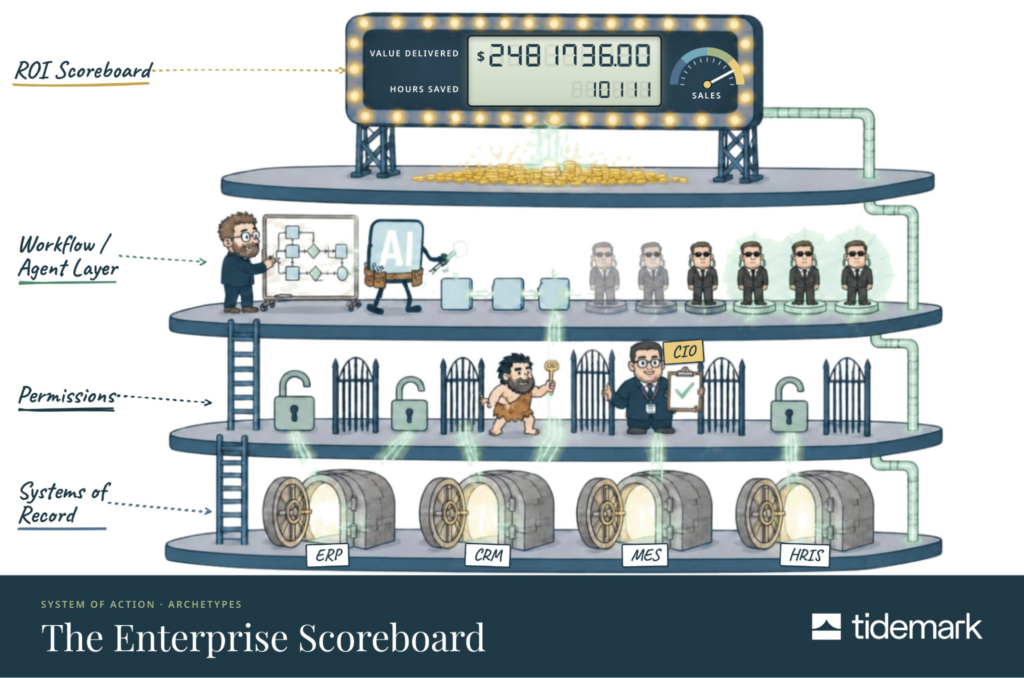
That’s your wedge. You’ve earned the right to integrate and surround. You start by tying into workflows, gathering context, and making yourself indispensable. That’s how a Native AI becomes the System of Action.
As the System of Action, users naturally want to feed you more context, more data, more touchpoints, because it leads to better outcomes. You now have usurped the Control Point’s data gravity by “supersetting” its data. With more data at your disposal, you earn the right to orchestrate workflows. And once you start learning from those outcomes, you have a system that self-improves in a positive reinforcement loop.

A true system of action is also a learning machine. It watches inputs, actions, and outcomes, and how people adapt. If you own the engagement layer, you see it all: The formal workflows and the informal stuff buried in Slack threads, hallway chats, and one-off spreadsheets. And once you see that, you can start to codify it, optimize it, and even automate it. A system of action can affect:
- Process discovery: You can capture and codify digitally how work gets done.
- Process understanding: You start to identify and understand bottlenecks, root causes, and recurring exceptions.
- Process conformance: You see how the actual process works versus the way you think it should be done, and decide if you want to make changes.
- Continuous learning/Process enhancement: Your outcomes improve via suggestions, nudges, or automation.
- Autonomous optimization and execution: The system becomes an intelligent action engine.
Coordinate action across external stakeholders, and an agentic system of action can “extend through the value chain.” First, the agents may coordinate communications between stakeholders — buyers, distributors, and suppliers. Then it may collect, reconcile, and aggregate data from different stakeholders and become a de facto industry ledger. Once these agents start triggering workflows across stakeholders, your system becomes the platform on which the industry runs.
Once these agents start triggering workflows across stakeholders, your system becomes the platform on which the industry runs. It all started because you found the jobs no one, not even cousin Richie, wanted to do.