The Enterprise Scoreboard
Four primitives, including an agreed Scoreboard. Makes n+1 agent/application a formality.

Here’s a pattern we’re starting to see at companies selling multiple products into large enterprises. Don’t look for a wedge into a market – look for a wedge into a single customer.
You build a control point inside one account, automate dozens of jobs to be done (JTBD), and get to seven figures of ARR. Each new product you sell into that account gets easier, until the next one is a formality.
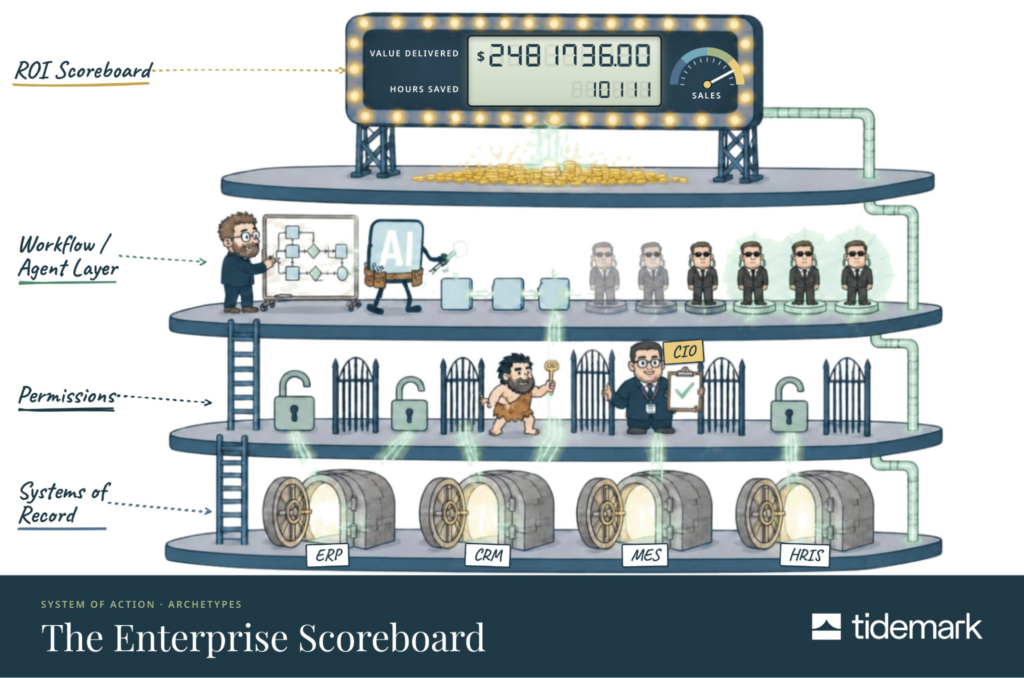
It takes four primitives that combine to create a multi-agent, multi-application archetype.
Sell Like a Consultant
Run discovery as a real mapping exercise — the industry and functional ontology, who does what, where the current work breaks. Ninety disciplined minutes with the operators, whiteboarding until you have a process map an engineer could build against.
As you go deeper, let agents handle the rest of the research: cross-client benchmarks, plus asynchronous agentic interviews and automated mockups that capture what the client’s subject matter experts know without the painful workshops. Do it well, and the context accrues whether you win the job or not. You emerge with an opinionated ontology seeded with the process expertise you hired and the industry knowledge you licensed.
This is so powerful that some companies running this play deliberately don’t charge for the mapping, recognizing that the context is the asset.
One CEO told us only one in six or seven of his discoveries ends in an application, and he still won’t charge for them, because charging would limit the context he builds. Sometimes this is the first time this context has been written down. It lives in people’s heads and only comes out when talking through the corner cases, exceptions, and workarounds that spring up in flight.
To do this well, you need to change your sales disposition. Think bespectacled McKinsey industry thought leader over meat-eating SAP DNA. You break in through a partner with real industry gravitas, or the retired utility CEO who gets you the mandate. Mid-level subject matter experts often do sales discovery, identifying the problem and charting a workflow in the customer’s language. That trades expensive sales talent for cheaper subject-matter expertise.
Turn Every Map into a Workflow
You need to turn maps into products fast — an agentic SDLC, a low-code framework, whatever gets you from process map to workflow. The process discovery discussed above is critical, but you still need a strong opinion on how the process should flow based on functional and industry depth.
Custom workflows are easy to build but hard to maintain. So build each workflow once, shared across all your customers, and let each customer tailor it with settings rather than custom code. The payoff is that each new workflow can bring in a new type of user. Each new user is new account gravity: another group whose buy-in you own.
Every workflow you turn on also forces an integration into an incumbent System of Record. The connector might take an hour, but data-access approval takes three months. So the first application is expensive, and the tenth is nearly free, and by then you’re plugged into the ERP, the asset system, the GIS, and the ledger. You are inside the account the way the incumbent is — not by relationship, but by permission.
The effect is strongest in risk-averse or highly regulated industries. Run the procurement gauntlet at a large bank, and they’ll want you to do as much as possible, because the alternative is vetting a new supplier.
Win the CIO
The business owner signs the first deal, but the CIO owns the integrations, data access, and security review that every workflow runs on.
Most large enterprises already carry a graveyard of bespoke builds. Show up as yet another, and the CIO will shut you down before you can get going.
To win the CIO’s heart and mind, you may need to provide her full-featured development environment, complete with control and governance: sandboxes, permissions, and an audit trail for every agent you provision and every change you ship (see Build UIs for builders in Account Gravity).
Agree on the Scoreboard
The Scoreboard is what turns the plumbing into account gravity (see The Scoreboard in Data moats).
Agree with the customer, in advance, on how the value of the work gets counted, and get them to sign off on the inputs before you run the analysis. The clean version is obvious attribution and a baseline you can prove — ingest two years of invoices, normalize spend down to the part number and the unit of measure, then show the delta once your agents go get more bids. The implied version is squishier but still works: agree that every time a workflow runs, it saves X hours of time and Y dollars of cost, then correlate usage to ROI.
This is an incredible position — an explicit, agreed link between product usage and the customer’s cost and revenue performance, ideally all the way through to EBITDA and enterprise value.
Put all four together. Once the Scoreboard exists and the customer believes it, application n+1 stops being a purchase decision. It can be built off existing Control Point integrations, it runs on context you already have, it ships into an environment IT already cleared, and both sides know roughly what it’s worth.
The JTBD may even be triggered by a workflow you already provide. Why wouldn’t they turn it on?