
 News
NewsAdaptive: Building the System of Action for Construction Finance



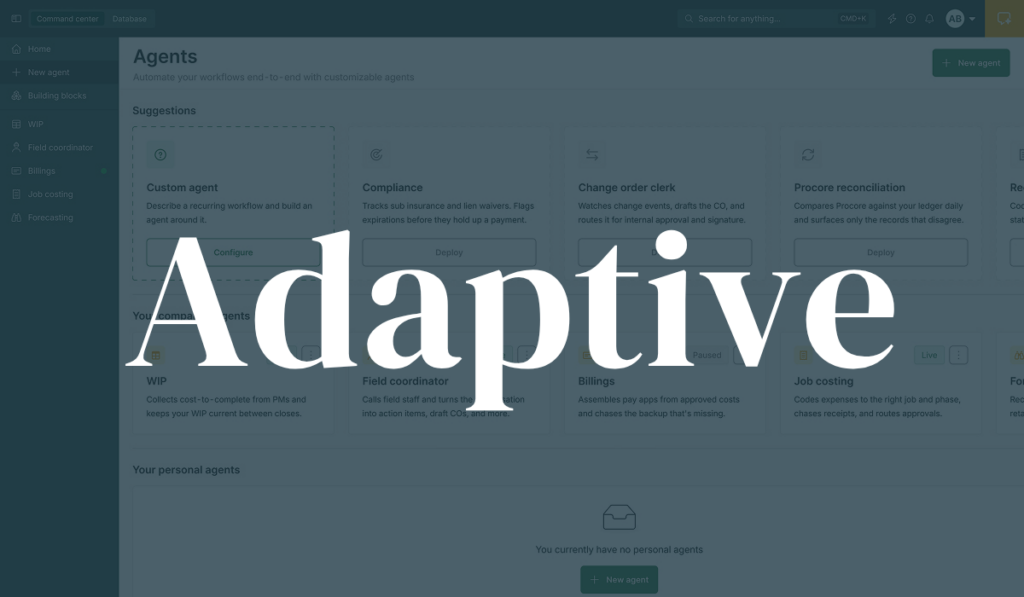
Construction companies do not lack software. They have general ledgers, ERPs, and project management systems. What they have historically lacked is a system that understands the story of a project well enough to do the financial work.
Construction accounting is a deeply collaborative job between the field and the back office. To know whether a project is on budget, an accountant needs to know what is actually happening on site: How far along is the job really? Does this invoice match the work that was actually done? Is there a change order that nobody has logged yet?
Much of that information never makes it into the ledger. It lives in schedules, daily logs, emails, texts, project management tools, bank and credit card accounts, and in the heads of people in the field.
So while the general ledger stores the numbers, finance teams still spend enormous amounts of time outside of it collecting the context that makes those numbers accurate, and very little on the work that matters most: spotting the overrun while there’s still time to fix it, catching the change order before it’s too late, and telling an owner which projects are making them money.
Adaptive was built to change that. Today, we’re thrilled to announce that Tidemark is leading Adaptive’s $30 million Series B.
The Coordination Problem at the Heart of Construction
Construction projects are non-recurring and constantly changing. Every project has a different combination of employees, customers, vendors, schedules, contracts, and exceptions. Even something as fundamental as “percent complete” can require judgment. Traditional accounting software is good at deterministic logic once the facts are known. The harder problem has always been finding and interpreting the facts.
Prior software waves tried to fix this by building one shared database and asking 25–30 people per project to keep their slice of it updated by hand. Anyone who has run a job knows how that goes. Nobody in the field wants another form to fill out, which is why the daily log, the typical record of what actually happened on site, is so often late, thin, or blank.
From Storing Data to Doing the Work
Adaptive’s agents work from two inputs. The first is the numbers: every bill, card charge, commitment, and change order, pulled directly from the accounting system, the bank, and the inbox. The second is the story in the field. Adaptive reads the daily logs, meeting transcripts, and jobsite photos a team already produces, and where that isn’t enough, it goes to the source, checking in with superintendents and project managers in the field by voice or text to track it down. Then it connects the two and does the work on top of it.
The company started with job costing: taking costs as they arrive and assigning them to the right job, cost code, and cost type. From there, Adaptive has expanded across workflows including accounts payable, billing, change orders, WIP, payments, and compliance. The underlying mechanism is the same: ingest the project context by gathering the numbers and the story, understand what they mean, and act.
Consider the work-in-progress (WIP) report, the document contractors use to judge whether a job is actually making money. A contractor needs to know the estimate, what has been billed and collected, and how far along the job really is. But the last piece often cannot be pulled from the accounting system. The schedule may be outdated. A delay may be buried in a daily log. A scope change may live in an email thread. The most accurate answer may still be in the head of a project manager or superintendent.
No system has captured that complete picture. Adaptive has the opportunity to create one.
At Tidemark, we’ve written extensively about the emergence of Systems of Action: applications that sit across existing systems of record, bring together the context required to make a decision, and then do the work. Adaptive is one of the clearest examples we’ve seen. It connects the financial data already sitting in accounting and project management systems with the unstructured context those systems were never built to hold, then reasons across both to execute the work.
A Mission-Critical Product Customers Love
Across our work, we repeatedly heard customers describe Adaptive as an “N of 1” product. For many, it has quickly become one of the most important tools in their technology stack.
The ROI is also tangible. Customers put it plainly: Adaptive is the bookkeeper they didn’t have to hire. As the business grows, the accounting team doesn’t have to grow with it.
That combination of a mission-critical workflow, hard-dollar ROI, and exceptional customer advocacy is rare.
It also gives Adaptive room to keep expanding. Each new workflow teaches the platform more about the project and the firm. The more it knows, the more its agents can do. And as more of the financial operation runs through Adaptive, the product becomes increasingly valuable to both the back office and the field.
What begins as automating individual accounting jobs has the potential to become the operating layer where a construction company understands the financial health of every project and takes action on it.
A Partnership Years in the Making
We have known Matt Calvano and the Adaptive team for years.
Matt became part of the Tidemark community early in the company’s journey, participating in our Vertical SaaS programming, Collective Live events, and conversations with operators across our network. Over time, we developed a shared language around Vertical SaaS, AI, and what it takes to build a true control point in construction.The more time we spent with them, the more we were impressed, not only by the business Adaptive had already built, but by Matt, Henry, and the team’s technical ambition and clarity about the opportunity ahead.
Construction is one of the largest and most operationally complex industries in the economy. We believe AI creates a once-in-a-generation opportunity to rethink how its financial work gets done, and Adaptive is emerging as the category leader doing it.
We’re proud to lead Adaptive’s $30 million Series B alongside existing investors Emergence Capital, Andreessen Horowitz, Pathlight, Definition, and 3KVC, and we’re excited to support Matt, Henry, and the entire Adaptive team as they build the System of Action for construction finance.
Hear more from Adaptive CEO, Matt Calvano, and Tidemark’s Dave Yuan and Andrew Walsh:


Stay in the Loop
Enter your details and be notified when we publish new articles on The Highpoint.